ORIA Double Treatment Station Review | Anti-Limescale Filter

Introduction
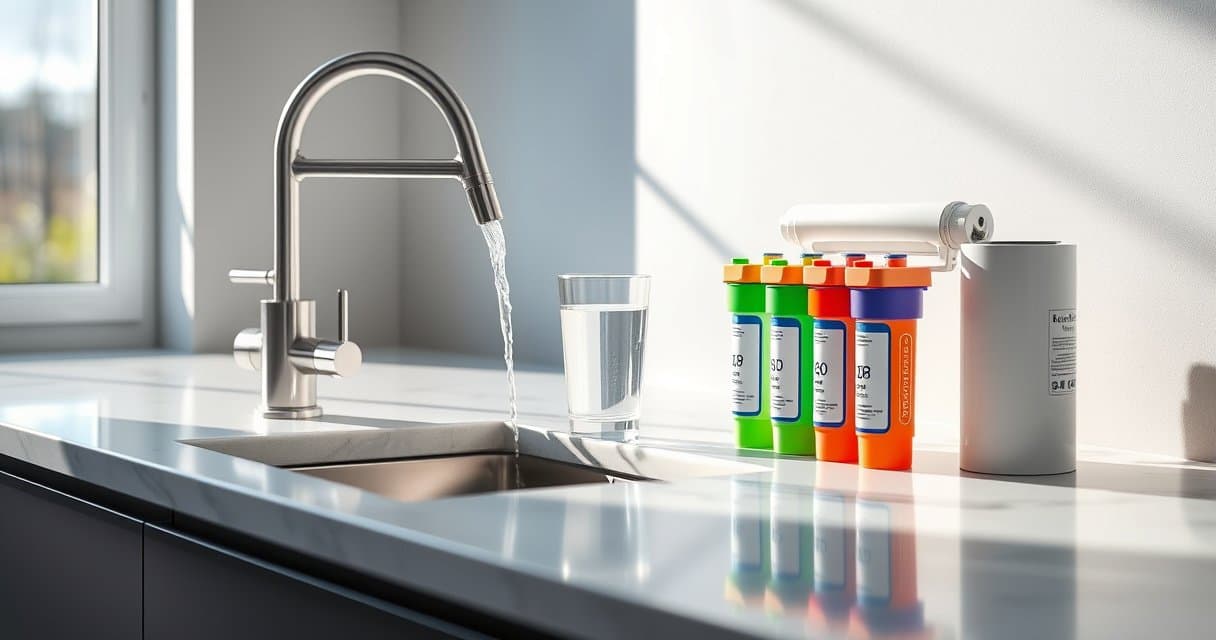
In the landscape of domestic water filtration, the offerings are vast and the technologies varied. Today, we are looking at a specific solution: the ORIA Double Treatment Station Anti-Limescale-Anti-Impurities. This is a double under-sink filtration station, designed to act on two fronts: reducing limescale and filtering solid impurities. This article aims to dissect its characteristics, its real effectiveness on water quality, and its relevance for daily family use, based on its technical specifications and feedback from the user community.
Strong Points
According to the manufacturer's specifications and customer feedback, several strengths stand out for this ORIA station.
Its simultaneous double treatment is its main argument. The combination of an anti-limescale cartridge (polyphosphate) and an anti-impurity cartridge (polypropylene wound) allows tackling two common problems in a single installation. Users confirm a noticeable improvement in the taste and odor of the water, often linked to the reduction of residual chlorine and suspended particles.
Its installation is described as accessible by a majority of users. The presence of a tightening/loosening key and standard 20x27 (3/4") connections facilitates assembly, often achievable without calling a plumber for experienced DIYers. Its moderate size (26 x 16 x 34.4 cm) makes it compatible with most under-sink cabinets.
Finally, the ACS certification (Sanitary Conformity Attestation) for all components in contact with water is an essential safety guarantee, ensuring the material does not release undesirable substances into the drinking water.
Weak Points
The analysis of feedback and the technologies used also highlights important limitations to be aware of before purchase.
The anti-limescale technology using polyphosphate has a preventive chemical action. It does not remove existing limescale but aims to limit its formation. Its effectiveness is considered moderate and contextual by experts, heavily dependent on the initial water hardness. It is clearly less performant than an ion-exchange water softener or an electronic scale inhibitor for protecting the entire plumbing system and large appliances.
The system has major shortcomings in the elimination of many contaminants. It does not treat nitrates, dissolved heavy metals (lead, copper), PFAS, pesticides, or small microplastics. It does not use a block activated carbon, which limits its capacity to adsorb residual organic and chemical compounds compared to more complete systems.
Some user feedback points to risks of leaks, particularly at the connections or seals, if the installation is not perfectly done or if the seals are poorly positioned. Although in the minority, these incidents are significant.
Detailed Analysis of Effectiveness and Technology
Which contaminants are actually targeted?
It is crucial to understand what this system does and does not do for health and water quality.
- Against Limescale (Scale) : Preventive action by chemical inhibition (polyphosphate). Effective for reducing deposits in kettles, coffee makers, and on faucets. Does not alter the hardness (TH) of water measured in a laboratory.
- Against Impurities : Mechanical filtration by the wound cartridge. It retains sediments, suspended particles (rust, sand), and some relatively large microplastics (generally down to 25 or 5 microns depending on the cartridge model used). It is a comfort and appliance protection filtration.
- Against Chlorine, Bad Tastes and Odors : An improvement is reported by users, likely due to mechanical filtration and a slight action from the filter media. However, without dedicated activated carbon, this action is limited and less effective than with a block or granular activated carbon filter.
- Not Treated : As mentioned, nitrates, fluorides, dissolved heavy metals, bacteria, viruses, volatile organic compounds (VOCs), and endocrine disruptors (like PFAS) are not eliminated by this technology.
Comparison with other market technologies
Let's put the ORIA Double Treatment Station into perspective against available solutions.
- Vs. Activated Carbon Filters (alone) : Activated carbon is far superior at removing chlorine, bad odors, and certain chemical contaminants. The ORIA, without this specific cartridge, is less performant on this aspect but adds the anti-limescale action.
- Vs. Reverse Osmosis : There is no possible comparison. A reverse osmosis system eliminates 95-99% of a very wide range of contaminants (heavy metals, nitrates, bacteria, viruses, salts, etc.). The ORIA is a basic prefiltration and anti-scale treatment in comparison. Reverse osmosis has a lower flow rate and generates water waste.
- Vs. Water Softener (ion exchange) : A water softener exchanges calcium and magnesium ions (responsible for limescale) for sodium ions. It actually removes water hardness for the entire house, offering complete protection. The ORIA's polyphosphate cartridge is an economical and localized solution, far less effective.
- Vs. Ultraviolet (UV) : UV light disinfects (bacteria, viruses) but does not filter impurities or limescale. The technologies are complementary, not competitive.
Long-term cost and maintenance
The annual cost is a major criterion. The station comes with two cartridges with an announced lifespan of 12 months for a household of 4 people. This figure is a standard estimate; the actual duration depends on water flow and impurity load. Replacement involves purchasing two specific cartridges (polyphosphate and wound). According to the ORIA range, the cost of these consumables is in the low average of the market, making it an economical system to maintain compared to reverse osmosis membrane systems or water softeners that require salt.
There is no water waste rate as it is not a reverse osmosis system. The flow rate is not limited by a membrane, only by a slight pressure drop due to the cartridges; it is therefore high and compatible with the simultaneous use of several downstream water points.
Technical Specifications
| Characteristic | Detail |
|---|---|
| Product Name | ORIA Double Treatment Station Anti-Limescale-Anti-Impurities |
| Technologies Used | 1. Limescale Inhibition (Polyphosphate) <br> 2. Mechanical Filtration (Polypropylene Wound Cartridge) |
| Targeted Contaminants | Sediments/Impurities (down to 5 or 25µm), Limescale (preventive action) |
| Contaminants NOT Treated | Nitrates, Dissolved Heavy Metals, PFAS, Pesticides, Bacteria/Viruses, Fluoride |
| Certification | ACS (Sanitary Conformity Attestation) |
| Cartridge Lifespan | 12 months (estimate for 4 people) |
| Installation Type | Under sink, on main water supply |
| Connection | Double female 20x27 (3/4") |
| Dimensions (L x W x H) | 26 x 16 x 34.4 cm |
| Power Supply | None (Mechanical system) |
| Maintenance | Annual replacement of both cartridges |
What Users Say: Summary of Reviews
The analysis of nearly 300 customer reviews, with an overall rating of 4.2/5, reveals clear trends.
Recurring Positive Points:
- Ease of Installation : A majority of users, like "Jean-Pierre CHERENE", emphasize that the product is "easy to install". The provided key and standard connections are appreciated.
- Perceptible Improvement : Feedback often reports better tasting water and a reduction of white deposits in kettles and coffee makers. "Oscar Vidal poza" notes that "the water improves its taste and color a lot".
- Initial Value for Money : For its purchase price, many feel the product "gets the job done" (Cedric PARDO) and is a good first step.
Points of Caution and Criticism:
- Risk of Leaks : This is the main reported problem. "Manjakely" reports a defect that led to a flood, despite changing the seals. Others advise "tightening well" and carefully checking the seals.
- Limited Anti-Limescale Effectiveness : Confirming the technical analysis, users on specialized forums consider this solution as a band-aid, not a water softener. Its effect is noticeable on small appliances but insufficient for very hard water or to protect a water heater.
- Sometimes Fragile Wall Mount : A few reviews, like "Alexandre's", mention that the wall mount can seem fragile once the station is filled with water, sometimes requiring reinforcement.
Conclusion
The ORIA Double Treatment Station Anti-Limescale-Anti-Impurities positions itself as an accessible and practical entry-level solution. Its main merit is combining two basic actions – sediment filtration and scale inhibition – in a simple-to-install pack, without electricity and with low-cost maintenance.
It is perfectly suited for a household looking to improve the taste of its drinking water and protect its small appliances (coffee maker, kettle) from deposits, in an area where the water is only moderately hard. It is an interesting option for those hesitant to invest in more complex systems.
However, it is essential to temper expectations. This system is not a complete water purification solution. It does not eliminate the most concerning dissolved contaminants for health (nitrates, heavy metals). Its action against limescale is palliative and limited compared to dedicated technologies. For households facing very hard water or concerned with thorough purification, opting for an ion-exchange water softener or a reverse osmosis system with prefiltration will remain the most effective and sustainable choice. The ORIA Double Treatment Station finds its place as a good first step towards better quality water, provided one precisely understands its scope of action.
100% free and independent — All our articles are written independently, without any sponsorship. We may earn a commission on purchases made through our links, at no extra cost to you.
Articles you might like
Alkaline Water Ionizer 11-Plate Electrode Test
Analyzes the 11-plate alkaline water ionizer: Does it filter water effectively, alter its properties, and deliver promised health benefits for a family?
TOODO Fleck 5800 SXT Monobloc Water Softener Review
Volumetric TOODO Fleck 5800 SXT water softener eliminates limescale efficiently for families. A review of features & performance.
Ecoviva E6 Reverse Osmosis Water Filter Review
Compact, tankless Ecoviva E6 reverse osmosis system analyzed. We test its real-world purification performance, health benefits, and home integration.
Guides you might like
Alkaline Water Ionizer Buying Guide
Discover how alkaline water ionizers work and learn key tips to choose the right one for your home and health. Essential buying guide.
Buying Guide: Best Hydrogen Water Generator
Guide to hydrogen water generators: cutting through the hype to help you make an informed purchase decision for your health and budget.
Choosing Your Home Water Filter
Unlock clean, tasty water at home. Find the right water filter to tackle chlorine, pollutants, and limescale for better health and peace of mind.