Pick the best water tester
You have probably already encountered that cloudy water droplet or whitish deposit in your kettle. Choosing the best water tester is precisely about taking back control over what is really in your glass. Because with heavy metals, stubborn limescale, or subtle nitrates, concerns are legitimate. Let's scrutinize the solutions together to see things more clearly, simply.
Key Points to Remember
- Start by identifying your precise concerns (health, limescale, taste) and consult your town hall's annual report before choosing a tester.
- Opt for a droplet test kit (titration) for a good balance between reliability and simplicity, especially for measuring hardness or chlorine.
- Be wary of low-end "all-in-one" electronic devices and prioritize accuracy over the number of parameters measured.
- Always interpret results with their units of measurement and compare them to health standards or your specific objective.
- Factor into your budget the cost of replacement reagents and necessary maintenance, especially for electronic testers.
Identify the contaminants you want to detect
The first question to ask yourself is not "what is the best water quality tester," but "what do I really want to know about my water?" Frankly, this is the number one trap: buying a generic device that gives you numbers without telling you what they mean for your health or your pipes.
Start by observing. Does your water have a strong chlorine taste? Does it form a lot of limescale in your kettle? These visual and taste clues are already valuable leads. Then, inquire with your town hall. In France, you have the right to consult the annual report on drinking water quality, which lists the main parameters of your network. It's free and provides an excellent reference baseline, especially for nitrates or hardness.
The main suspects and how to track them
Not all contaminants require the same level of analysis. Here are the most common ones, categorized by type of concern:
-
For health (taste, toxicity):
- Chlorine and derivatives: The simplest target. A strong swimming pool smell? That's it. A good electronic tester or even dedicated test strips detect it in seconds. It's often the first parameter to check if you are considering an activated carbon filter.
- Heavy metals (lead, copper, mercury): More insidious. They are often linked to old pipes. Chemical reaction test kits (with color change) are reliable for domestic use but require careful handling. If you have a serious doubt, a laboratory analysis remains the most reliable, but also the most costly, option.
- Nitrates and pesticides: A major issue in agricultural areas. High-end multi-parameter electronic testers can measure them, but specific drop or test strip kits often offer a better accuracy/price ratio for these compounds.
-
For your home and appliances:
- Limescale (water hardness): This is THE most useful measurement for protecting your appliances and your skin. Hardness is expressed in French degrees (°fH or TH). Water is considered hard from 25-30 °fH upwards. A titration test (kit with drops that change color) is incredibly simple, precise, and inexpensive. Essential before investing in a water softener.
- pH: Too basic or too acidic, water can corrode pipes or make disinfectants less effective. It's an easy measurement with most testers.
My personal advice? Don't try to measure everything at once if you're a beginner. Focus on 2 or 3 parameters that match your real concerns. Investing in a tester that promises to analyze everything but is complicated to calibrate, you'll end up leaving it in a drawer. Start with a hardness and chlorine test, that's already a wealth of information for choosing a suitable filtration system.
Test Strips, Electronic Meters, or Kits: The Right Format for Your Use
Now that you know what to look for, you need to choose your detection tool. This is where most people make a mistake, thinking an electronic tester is necessarily "better." It's not that simple. Each format has its strengths, weaknesses, and most importantly, its own playing field. It's a question of context, not absolute superiority.
Test Strips: Speed (But with Limits)
You dip the strip into a glass, wait a few seconds, and compare the colors to a chart. It's instant, not bulky, and really inexpensive. Perfect for a quick check of chlorine, pH, or total hardness when you've just installed a new filter.
But be realistic about their accuracy. Reading colors is subjective – under poor lighting, it's a lottery. They are also very sensitive to moisture: a poorly closed box, and the entire pack is ready to be thrown away. For a serious diagnosis of parameters like nitrates or lead, frankly, look elsewhere.
Liquid Reagent Test Kits (Titration)
You've seen those little vials with a dropper, right? That's the colorimetric kit method. You add drops of reagent to a water sample until the color changes. It's more technical than a test strip, but the accuracy is much higher, especially for hardness (TH/TAC) or total chlorine.
This is my favorite for a perfect balance between reliability and domestic simplicity. A good hardness kit costs about fifteen euros and can last for years. The process takes two extra minutes, but the result is reliable. It's the ideal tool for validating the effectiveness of a water softener, for example.
Electronic Testers: Precision at a Price
Here, we move into another category. A digital screen displays a numerical value, often to the tenth of a unit. It's impressive and practical for very frequent measurements, like pH control in a sophisticated aquarium or for a swimming pool.
But beware of the flip side. These devices require regular calibration with calibrated solutions, otherwise their readings drift and become less reliable than those of a simple test strip. The electrodes wear out and their replacement can cost almost as much as the device. And to be frank, a low-end model at €30 that promises to measure everything is rarely a good investment; it will be inaccurate and fragile.
So, which is the best water quality tester for you? Ask yourself these two questions: How often will I use it? And what level of reliability is necessary for my decision? For an occasional and simple check, test strips or a kit are sufficient. For rigorous, daily monitoring, electronic meters find their justification, provided you accept their maintenance.
Our Selection
Whether you're passionate about aquariums, hydroponics, or simply concerned about your drinking water quality, a suitable tester is a valuable tool. In this selection, we analyze three distinct models based on their technical specifications and user feedback, to help you discern their respective strengths and limitations.
| Product | Main Measurements | Accuracy / Range | Strengths (according to reviews) | Points to note |
|---|---|---|---|---|
| Aideepen Water Quality Tester | TDS, EC, Temperature | Accuracy ±2% / 0-9999 ppm/µS | Clear display, compact and non-slip design | Manual calibration required (solution not included) |
| Pious PH Meter | pH, TDS, EC, Salinity, Temperature | Accuracy ±0.01 (pH) / Wide range | 5-in-1 versatility, automatic calibration included, backlight | More bulky, requires stabilization for pH measurement |
| TDS Meter Digital | TDS, EC, Temperature | Limited range (0-999 ppm) / Accuracy not specified | Lightweight and portable, batteries included, ease of use | Limited range for advanced applications, few user reviews |
Aideepen Water Quality Tester
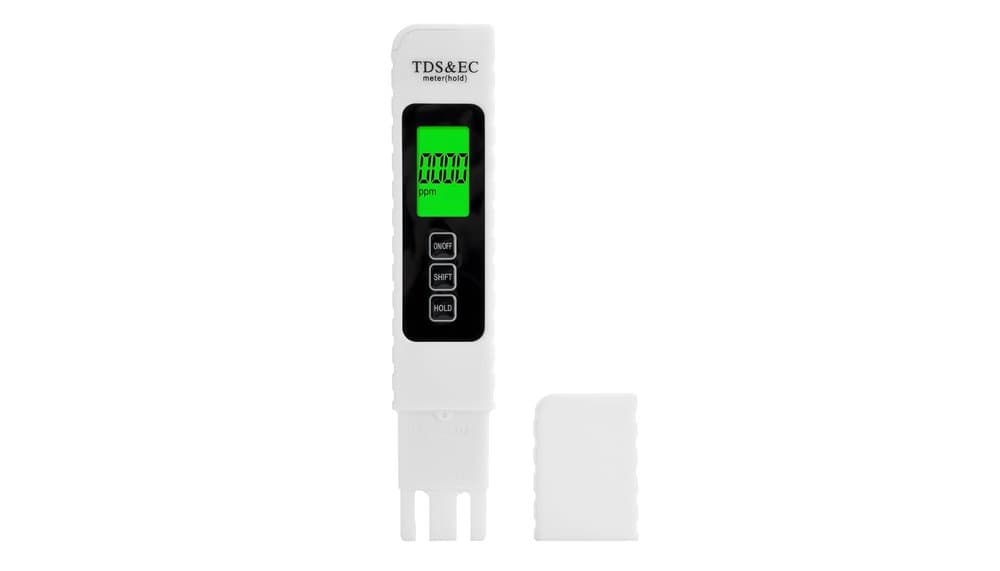
The Aideepen Water Quality Tester positions itself as a 3-in-1 instrument (TDS, EC, Temperature) for domestic and hobby use. On paper, its specifications promise good versatility for testing tap water, aquarium water, pool water, or water used in horticulture, with a stated accuracy of ±2%.
The user community highlights several concrete strengths. Its backlit LCD screen is considered very readable, and its integrated design with a non-slip grip is appreciated for handling, especially with wet fingers. According to feedback, it is considered simple and quick to use: one press to measure, another to hold the value. Its battery life, thanks to an easily replaceable CR2032 coin cell, also seems satisfactory for occasional use.
However, the analysis of reviews and specs also reveals limitations. The most frequently raised point is the need to calibrate it yourself to guarantee its long-term accuracy. The calibration solution is not provided in the pack, which represents an additional step and cost. Furthermore, even though its measurement range (up to 9999 ppm) is wide, a few users note that it can lack responsiveness on very low measurements (like pure RO water), which is consistent with its stated 2% accuracy. In summary, it is a reliable and practical tool for regular checking in many contexts, but requires a small initial investment in calibration for those seeking optimal accuracy.
Pious PH Meter
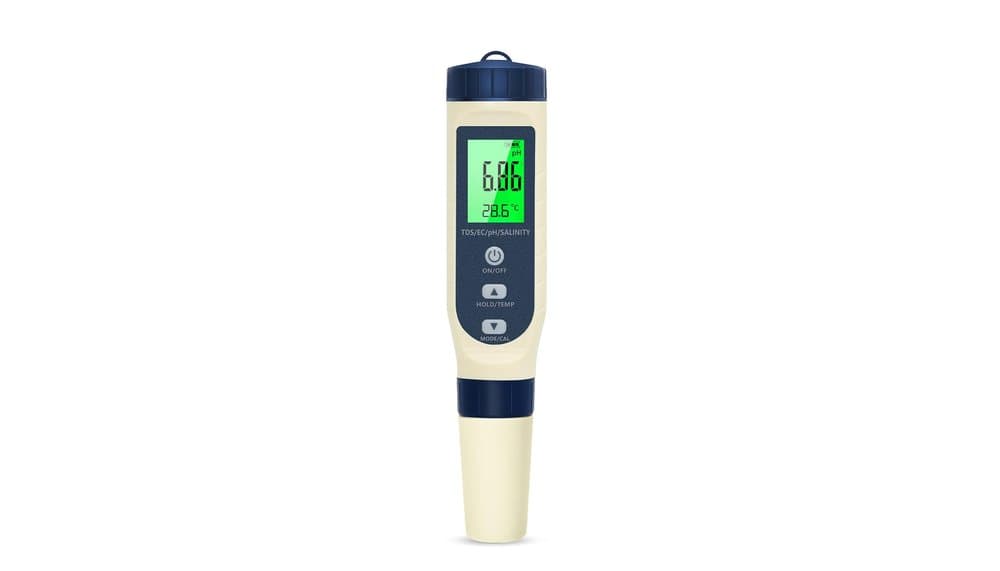
With its 5-in-1 approach, the Pious PH Meter clearly targets users needing a more comprehensive water analysis. It stands out by measuring not only TDS, EC, and temperature, but also pH and salinity. On paper, it's the most versatile device in this selection, with a stated pH accuracy of ±0.01.
Community feedback highlights this versatility as its main asset. It is particularly favored by saltwater aquarium hobbyists and saltwater pool owners, for whom salinity monitoring is crucial. The inclusion of a three-point calibration kit (4.01, 6.86, 9.18 solutions) is highly appreciated, as it allows for simple automatic calibration and guarantees accurate pH measurements upon receipt. Its backlit screen and HOLD function to freeze values are also cited as practical points.
However, this versatility comes at a cost in terms of user experience. According to reviews, the device is larger and heavier (96g) than its competitors, making it less "pocketable". Most importantly, pH measurement requires a certain rigor: users note that you must wait for the display to stabilize (several seconds) and sometimes gently agitate the probe for reliable results. The manual itself indicates that the display may "jump" in the air, which is normal but can be confusing. Finally, although factory calibrated, its regular maintenance (cleaning and recalibration of the pH probe) is essential to maintain its accuracy. It is therefore the most comprehensive and precise tool, but one that requires a bit more know-how and patience.
TDS Meter Digital Drinking Water Tester
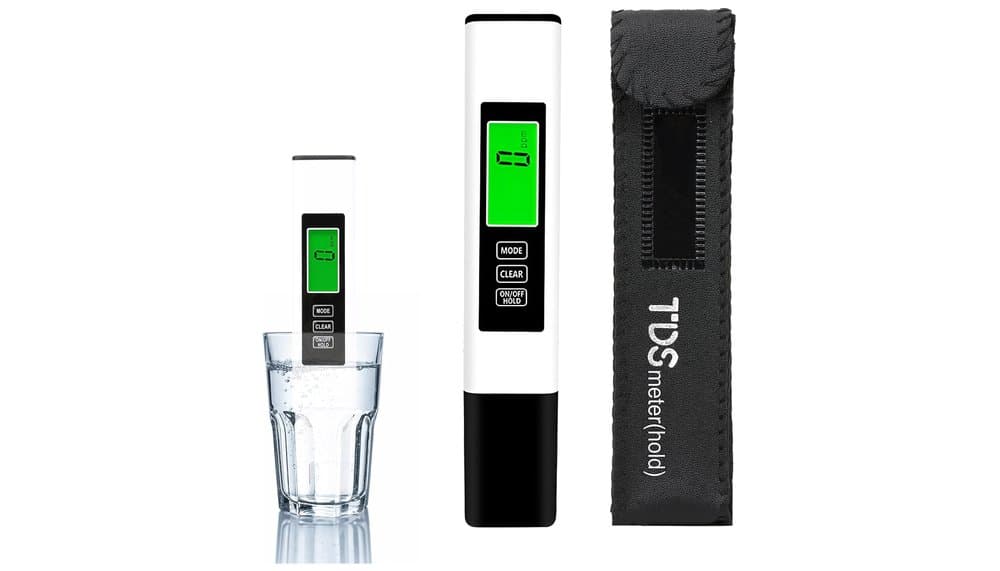
The TDS Meter Digital Drinking Water Tester embodies the simple and accessible philosophy. This 3-in-1 device (TDS, EC, Temperature) presents itself as a basic, ready-to-use solution for quick checks. On paper, its specs primarily destine it for checking drinking water, freshwater aquariums, and basic hydroponics.
What emerges from the early user reviews, although few, is its disconcerting simplicity. Its main strength, according to this feedback, is being extremely lightweight (10g) and compact, shipped with its LR44 batteries already installed. You take it out of the box, dip the probe, and the reading appears almost instantly on the LCD screen. It is perceived as a tool ideal for an occasional check of tap water hardness or the general state of an aquarium.
However, this simplicity comes with significant compromises. Its TDS measurement range is limited to 999 ppm, making it unsuitable for testing very hard water, seawater, or some concentrated hydroponic nutrient solutions. Its accuracy is not clearly specified by the manufacturer, a point that more demanding users might see as a lack of transparency. Unlike the other models, it does not include a calibration solution and does not mention a calibration procedure in its specifications, which questions its long-term reliability. In summary, it is a practical and economical gadget for very basic uses, but it lacks robustness and versatility for serious or regular applications.
Choosing Between Immediate Ease and Long-Term Accuracy
This is the central dilemma. Do you want a quick, understandable result, or reliable data that retains its value over time? This decision impacts everything: your budget, your routine, and, most importantly, the trust you will place in the numbers you obtain.
The Trap of the "All-in-One" Ease
A device promising to measure 10 parameters in 30 seconds, without calibration, with a single probe. It's tempting, obviously. But be wary. In reality, the technology for a single electrode capable of accurately detecting elements as different as chlorine, nitrates, and heavy metals simply does not exist for the general public. This type of promise often hides an approximate electronic processing of data, which gives a number, but not necessarily the truth.
You risk buying a gadget that reassures you in the moment, but whose results cannot guide you in choosing a suitable filter. Frankly, a tester that displays a value for "lead" without specifying whether it's in ppb (parts per billion, the standard) or in a made-up unit is a red flag.
Investing in Reliability: What It Entails
Lasting accuracy has a cost and conditions. Let's take a dedicated electronic tester, like a quality pH meter or TDS meter.
- The Commitment to Calibration: You will need to calibrate it every month if you use it often, with reference solutions (pH 4.0 and 7.0, for example). A kit of solutions costs about 15€ and lasts a year. Forget this step, and your measurement drifts – sometimes by more than a full pH unit, making the result worse than useless.
- Storage Conditions: The probe must never dry out. You will need to rinse it with demineralized water and keep it moist in a cap with a specific storage solution. Leaving it lying on the sink is signing its premature death warrant.
- A Realistic Lifespan: A good electrode, well maintained, can last 1 to 2 years. Once it no longer calibrates correctly or the response becomes very slow, it must be replaced.
What Balance for You?
Here's how to decide. If your need is occasional – checking the effectiveness of a new carbon filter on the taste of chlorine, or getting a first idea of your water hardness – a colorimetric test kit is the perfect balance. It is more accurate than a test strip, does not require calibration, and gives you a concrete result in a few minutes.
On the other hand, if you manage a sensitive reef aquarium or if you are closely monitoring the output quality of a reverse osmosis system, then the investment (in time and money) in a good dedicated electronic tester is fully justified. Constant accuracy takes precedence over simplicity.
The best water quality tester is therefore the one whose usage protocol you will know – and want – to follow. A precision tool poorly maintained becomes less reliable than a simple tool used correctly.
Read and Interpret Results Like a Pro
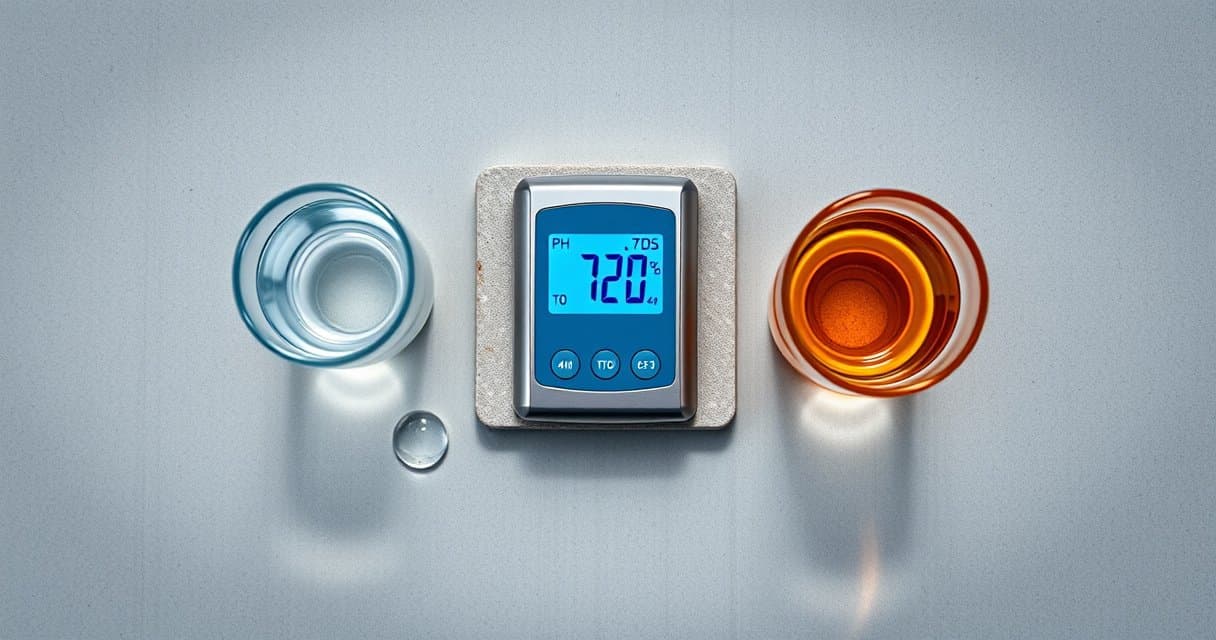
Getting a number on the screen or a color on a test strip is one thing. Knowing what it means for your tap water or your filtration system is another. This is where the real work begins – and where you transform a simple measurement into useful decision-making.
Understanding the Unit of Measurement, That Crucial Little Thing
This is the first pitfall. A result without the correct unit is nonsense. Take hardness (limescale). In France, it is often given in French degrees (°fH or °TH). If your tester gives you a value of "68", but in ppm (parts per million) of calcium carbonate, you are not at 68°fH, you are at about 38°fH – a huge difference! Always check the manual. The same goes for heavy metals like lead or copper: health standards are in micrograms per liter (µg/L), which are equivalent to parts per billion (ppb). A device that displays in "ppm" (parts per million) for these contaminants would be completely unsuitable, because legal limits are on the order of tens of ppb. That would be like using a tape measure to gauge the thickness of a sheet of paper.
An Isolated Value Means (Almost) Nothing
A TDS meter reads 350 ppm. Is that bad? Not necessarily. It all depends on the composition. Those 350 ppm could be 95% perfectly healthy minerals like calcium and magnesium, or they could contain nitrates and sodium in concerning proportions. This is the major limitation of TDS: it is a total measurement, not an analysis. Professional interpretation involves cross-referencing data. For example, a low pH (acidic) combined with a high copper reading is a much more serious warning sign than either of those values alone, because acidic water can corrode copper pipes. Your best water quality tester is therefore often a combination of several tests that complement each other.
Contextualize with Standards and Your Goal
Finally, compare the result to a reference. For drinking water, consult French regulatory limits or WHO recommendations. A nitrate level of 30 mg/L is below the legal limit (50 mg/L), but it is already significant and would justify installing a specific filter if it's your daily drinking water. But your personal goal sometimes comes first. For a shrimp aquarium, a hardness (GH) of 15°fH would be catastrophic, whereas it is perfectly ordinary for tap water. For the water in a steam iron, you aim for a TDS as close to zero as possible, well below any drinking water standard. Don't always aim for "zero." Aim for "appropriate." That's what reading results like a pro is all about.
The Real Budget: Purchase, Reagents, and Maintenance to Consider
The classic mistake? Focusing only on the price at the register. Honestly, it's like buying a printer without considering the cost of cartridges. The true cost of a tester is calculated over two or three years, especially if you plan regular tests to manage your filtration system. Let's examine everything under a magnifying glass.
The Entry Price: A Mirage
You can find basic electronic TDS meters for 15 euros, and multi-parameter colorimetric kits for over 150 euros. The temptation of the cheapest option is strong. But beware: a 15-euro tester often means a low-end sensor of dubious accuracy, a fragile casing, and zero possibility for calibration. It will give you a trend, not a reliable measurement. For very occasional use, maybe. For seriously tracking the efficiency of a reverse osmosis cartridge, it would be a poor calculation. Investing 60 to 100 euros in a model with a replaceable probe and calibration function is often much more cost-effective in the long run.
The Hidden Bill: Consumables and Reagents
This is the point that really makes the difference. Test strips seem economical? A bottle of 50 strips for chlorine/pH costs about 20 euros. If you test your pool twice a week during the season, you'll need two bottles per year. It adds up fast. Kits with reagent drops (for nitrates, hardness, metals) each have a limited shelf life. A bottle of nitrate reagent can cost 12 euros and allow for 50 tests. If your goal is overall monthly monitoring, budget 30 to 50 euros per year to replenish the most used bottles. Neglect this point, and your nice kit becomes a paperweight in six months.
Maintenance, The Costly Oversight
Electronic testers worthy of the name require maintenance. For models with an electrode (pH meters, for example), you need a specific storage solution to prevent the probe from drying out and dying prematurely. Budget 10 euros every six months. Calibration is crucial. Calibration solutions (pH 4.0 and 7.0, for example) need to be replaced. A pack costs around fifteen euros. Some high-end devices require annual professional calibration, which can reach 80 euros. Ask yourself if you are ready for this rigor. My advice: before choosing, do the following calculation: [Purchase Price] + ([Annual Reagent Cost] x 3) + ([Maintenance Cost] x 3). It's this figure that will tell you if the best water quality tester for you is truly within your budget.
Conclusion
In summary, choosing the best water tester is not just a matter of gadgets or numbers. It's a personal decision.
Weigh what truly matters to you: simplicity or precision, initial cost or long-term reliability. Your daily life, your concerns, your installation.
A good tester finally gives you clear answers. It allows you to act with full knowledge to protect what you drink and use every day.
Take the time to choose well. Your water is worth it.
Frequently Asked Questions
What is the most reliable water tester for domestic use?
A liquid reagent test kit (titration) offers the best balance between reliability and simplicity for occasional use, particularly for measuring hardness or chlorine. Electronic testers can be very precise but require regular calibration to maintain their reliability.
How to effectively test water hardness (limescale)?
For an accurate measurement of hardness (TH), use a titration test kit with drops that change color, expressing the result in French degrees (°fH). Water is considered hard starting at 25-30 °fH, which is crucial to know before considering the purchase of a water softener.
Can you trust water test strips?
Test strips are fast and inexpensive for a quick check of chlorine or pH, but their accuracy is limited due to a color reading that is often subjective. They are not recommended for serious diagnosis of contaminants like nitrates or heavy metals.
Which tester to detect heavy metals in water?
For a suspicion of heavy metals (lead, copper), chemical reaction test kits with a color change are reliable for an initial domestic diagnosis. For a certain result, a laboratory analysis remains the most reliable option, although more expensive.
What budget should be planned for regular water testing?
The real cost includes the initial purchase, replacement reagents, and maintenance, with an annual budget potentially ranging from 30 to 50 euros for the consumables of a colorimetric kit. An electronic tester requires an additional investment for calibration solutions and probe storage.
100% free and independent — All our articles are written independently, without any sponsorship. We may earn a commission on purchases made through our links, at no extra cost to you.
Guides you might like
Alkaline Water Ionizer Buying Guide
Discover how alkaline water ionizers work and learn key tips to choose the right one for your home and health. Essential buying guide.
Buying Guide: Best Hydrogen Water Generator
Guide to hydrogen water generators: cutting through the hype to help you make an informed purchase decision for your health and budget.
Choosing Your Home Water Filter
Unlock clean, tasty water at home. Find the right water filter to tackle chlorine, pollutants, and limescale for better health and peace of mind.
Articles you might like
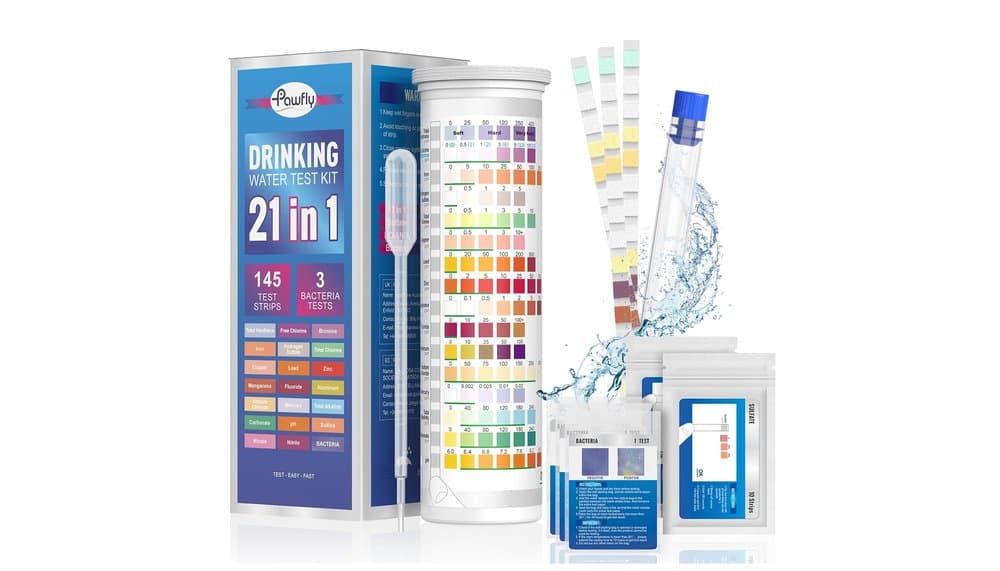
Pawfly 21 in 1 Drinking Water Test Kit Review
Pawfly test kit reviews a 21-in-1 water test strip, analyzing accuracy & value for home tap, well, or aquarium water tests. Get key insights before buying.
Lafiucy 10 Inch Coconut Carbon Filter Review
Review of the affordable Lafiucy 5 Microns 10-inch activated carbon water filter cartridge, analyzing specs & user feedback for performance.
ALTHY Performance Hydrogen Water Bottle Review
Transform water into antioxidant-rich hydrogen water anywhere with the ALTHY portable bottle. A powerful, on-the-go wellness innovation.