WK Polyphosphate Refill Tablets Review
Introduction
Looking to protect your plumbing and household appliances from limescale without investing in a complex system? The WK Polyphosphate Refill Tablets presents itself as a simple, concentrated add-on solution. But what is its real role in the home filtration ecosystem? We are going to demystify this product.
It's crucial to understand from the outset what this product is not: it is neither a drinking water filter, nor a purifier. It does not clean water for human consumption. Its action is purely technical and preventative, intended to protect pipes and appliances. We will analyze it from the angle of plumbing protection, comparing its mode of action with the water treatment technologies we know well.
Strong Points
The advantages of WK Polyphosphate tablets lie in their simplicity and their well-defined technical target.
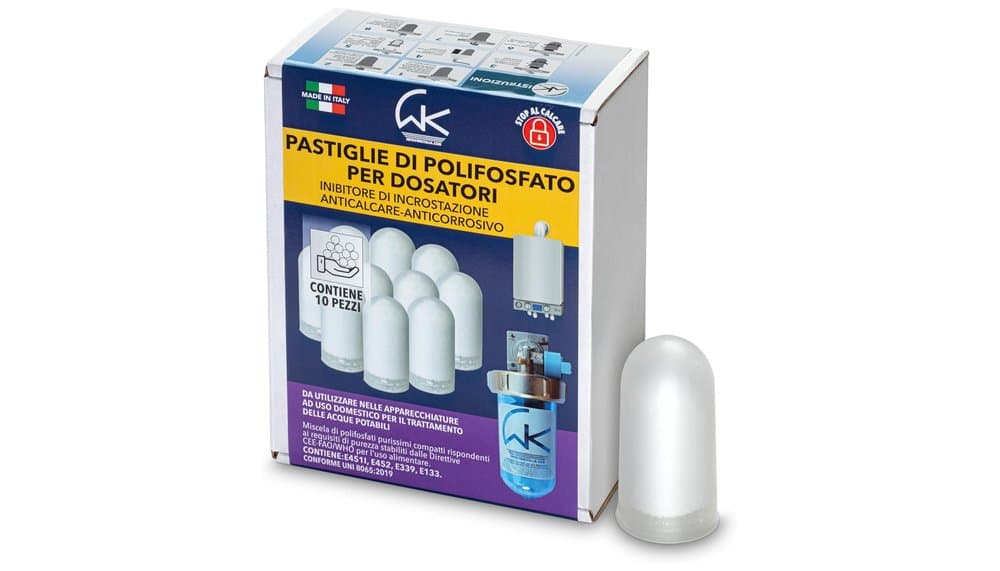
Simplicity of installation and maintenance The product comes in the form of individually pre-dosed tablets, packaged in a plastic tube. Installation simply involves opening the existing dispenser (usually a small in-line housing on the main water line), removing the tablet from its packaging, and placing it inside. According to user feedback, this operation requires no specific tools or advanced plumbing skills.
Triple action: anti-limescale, anti-corrosion, self-disinfecting The specifications highlight three key actions. The main one is limescale inhibition: polyphosphates envelop calcium carbonate crystals (limescale) to prevent them from clumping together and depositing on surfaces. They also form a protective film inside pipes, limiting metal corrosion. The self-disinfecting property is often linked to this layer which can inhibit the development of certain bacterial biofilms.
Value for money for equipment protection Compared to installing a salt-based ion exchange water softener (which requires salt, drainage, and significant space) or a reverse osmosis system (which has a completely different purpose), the initial investment and cost of consumables are very low. It is an economical first-line barrier to extend the lifespan of boilers, water heaters, washing machines, and dishwashers.
Weak Points
These strengths should not hide the significant limits of this technology, which must be understood before any purchase.
Does not purify drinking water This is the most critical point. The WK Polyphosphate Refill Tablets do not remove any contaminants from water intended for consumption. They eliminate neither chlorine, nor heavy metals (lead, copper), nor nitrates, nor PFAS, nor microplastics, nor bacteria. Their action is additive: they add polyphosphates to the water. For purified drinking water, you need to turn to other technologies (activated carbon, reverse osmosis, UV).
Preventative action, not curative The product is designed to prevent the formation of new limescale deposits. On the other hand, it is completely ineffective at dissolving limescale already present in pipes or heating elements. If your system is already scaled, these tablets will not change anything.
Variable lifespan and requires monitoring The lifespan of a tablet, stated as "2/3 weeks" by some users for boilers, can vary greatly. It depends on the total water flow passing through the dispenser and the initial water hardness (calcium and magnesium content). This requires regular monitoring to replace the tablet once dissolved, otherwise you risk leaving the installation unprotected.
Technical usage limits Expert testers point out that these polyphosphate systems are sensitive to conditions. They must be installed on cold water (generally upstream of any water heater) and at moderate pressure (often below 5 bars). Temperature or pressure that is too high can cause them to dissolve too quickly or less effectively. It is also advised to place them after a sediment pre-filter to prevent them from clogging with impurities.
Detailed Analysis
Technology and real effectiveness against contaminants
To properly situate the product, let's compare it with the main domestic water treatment technologies.
- Against limescale: The product uses polyphosphate technology, a sequestration/conditioning process. It is radically different from ion exchange (water softener) which removes calcium and magnesium ions from the water and replaces them with sodium. Polyphosphates remove nothing; they modify the behavior of limescale. It is therefore less effective than a water softener for very hard water, but sufficient for basic protection. No action on other contaminants.
- Against other pollutants: Ineffective. For organic matter, chlorine, bad tastes and odors, you need an activated carbon filter. For nitrates, heavy metals, fluorides, and the majority of micro-pollutants, reverse osmosis filtration is the only truly effective domestic technology (with a rejection rate that can reach 95-99% for these contaminants). For bacteria and viruses, only UV treatment is reliable. Polyphosphate tablets have no role in these areas.
Size and Installation
This is where the product excels. A standard polyphosphate dispenser is a small cylinder (like a "big blue" 10-inch or smaller) that installs in-line on the main cold water supply line, usually in the basement or a utility room. The footprint is minimal, especially compared to a water softener (which also needs a salt tank) or an RO system (which includes several cartridges and an under-sink tank). According to the community, installing the dispenser itself may require a plumber to cut and connect the piping, but replacing the tablet is within anyone's reach.
Annual Cost and Maintenance
The cost is primarily that of replacement tablets. A pack of 10 WK tablets, depending on the replacement frequency (function of flow and hardness), can cover several months to a year of consumption for a standard household. This cost is significantly lower than the annual maintenance of a water softener (salt, disinfection) or replacing the consumables of a reverse osmosis system (pre-filters, membrane, post-filter). Maintenance is limited to replacing the tablet and, occasionally, cleaning the dispenser body once a year. There is no wastewater discharge, unlike reverse osmosis or a water softener's regeneration cycle.
Technical Specifications
To summarize the key data, here is a recap table of the characteristics of the WK Polyphosphate Refill Tablets.
| Characteristic | Detail / Value |
|---|---|
| Product Name | WK Polyphosphate Refill Tablets |
| Format | 10 individually wrapped super-concentrated tablets |
| Main Action | Anti-limescale, anti-corrosion conditioning |
| Use Target | Protection of installations (pipes, boilers, appliances) |
| Compatibility | Standard proportional polyphosphate dispensers |
| Indicative Lifespan | Variable: from a few weeks to a few months depending on flow and hardness |
| Health Relevance | None – Does not purify drinking water. Technical use only. |
| Installation | Simple tablet replacement in an existing dispenser |
| System Footprint | Requires a dispenser (small in-line cylinder on piping) |
| Consumption | One tablet dissolves gradually in contact with water flow |
| Production/Flow Rate | Does not affect the water network flow rate |
| Wastewater | None |
| Approximate Annual Cost | Depends solely on the number of replacement packs needed |
What Users Say
The synthesis of 5840 customer reviews (overall rating 4.6/5) and expert feedback on forums reveals a clear consensus, with specific praise and recurring reservations.
Recurring positive points:
- Perceived anti-limescale effectiveness: Many users, especially in hard water areas, report a visible reduction in white deposits on faucets, shower walls, and better longevity of their appliances' heating elements. Phrases like "does the job" or "protects the boiler well" come up often.
- Simplicity and convenience: The ease of replacement is highly praised. "You open it, put it in, close it. Done for several months" sums up the general feeling. The individual tablet packaging is also appreciated for its cleanliness.
- Value for money: For a modest cost, users feel they get effective protection without heavy maintenance for their installation. The implicit comparison with the cost and bulk of a water softener is frequent.
Negative points or necessary clarifications:
- Misunderstanding of use: Several disappointed customers expected "softened" water for skin or purification. The community and experts have to reiterate that this is not a water softener in the classic sense and that the treated water still "feels hard" (the minerals are still present).
- Uneven lifespan: This is the most variable point. While some observe a lifespan of several months, others, with high water flow or very hard water, have to replace the tablet every 3 to 6 weeks. This implies active vigilance from the user.
- Sensitivity to conditions: Expert feedback confirms that for optimal effectiveness, respecting the pressure and temperature limits is imperative. Installation on a hot water line would render the product virtually ineffective.
Conclusion
The WK Polyphosphate Refill Tablets are a specialized and effective product within its domain, provided you understand that domain clearly. It is not a miracle solution for the whole house, but an intelligent technical protection component.
Our analysis is clear: if your goal is to improve the sanitary quality of your drinking water, to eliminate specific contaminants, or to obtain truly softened water, this product is not for you. You should look towards filtration systems (activated carbon) or reverse osmosis.
On the other hand, if you are looking for a simple, economical, and low-footprint protection for your pipes, boiler, water heater, and appliances against the harmful effects of limescale and corrosion, these tablets represent an excellent choice. Their ease of use and low operating cost make them a very pertinent first line of defense for many households.
For comprehensive protection, it's entirely possible to consider coupling this technical system with a specific drinking water filter (like a pitcher filter or under-sink RO system) to address the two distinct needs: protecting the installation and purifying the water for consumption.
100% free and independent — All our articles are written independently, without any sponsorship. We may earn a commission on purchases made through our links, at no extra cost to you.
Articles you might like
Alkaline Water Ionizer 11-Plate Electrode Test
Analyzes the 11-plate alkaline water ionizer: Does it filter water effectively, alter its properties, and deliver promised health benefits for a family?
TOODO Fleck 5800 SXT Monobloc Water Softener Review
Volumetric TOODO Fleck 5800 SXT water softener eliminates limescale efficiently for families. A review of features & performance.
Ecoviva E6 Reverse Osmosis Water Filter Review
Compact, tankless Ecoviva E6 reverse osmosis system analyzed. We test its real-world purification performance, health benefits, and home integration.
Guides you might like
Alkaline Water Ionizer Buying Guide
Discover how alkaline water ionizers work and learn key tips to choose the right one for your home and health. Essential buying guide.
Buying Guide: Best Hydrogen Water Generator
Guide to hydrogen water generators: cutting through the hype to help you make an informed purchase decision for your health and budget.
Choosing Your Home Water Filter
Unlock clean, tasty water at home. Find the right water filter to tackle chlorine, pollutants, and limescale for better health and peace of mind.