iSpring EDV2 Electronic Descaler System Review & Test
Introduction
In the world of domestic water treatment, the fight against limescale is a central concern. We are constantly searching for solutions to protect our pipes, our household appliances, and our comfort, without increasing the maintenance burden or altering the quality of the water we drink. It is in this context that the iSpring EDV2 Electronic Descaler Anti-Limescale System positions itself, an electronic water conditioner that promises to combat scale without salt, without chemicals, and without complex installation. But what is it really worth against our standards for water quality and health? This article deeply analyzes its specifications, its operation, and real-world feedback to determine if it is a relevant solution for your home.
Key Strengths
The promise of the iSpring EDV2 rests on several appealing arguments for the modern consumer.
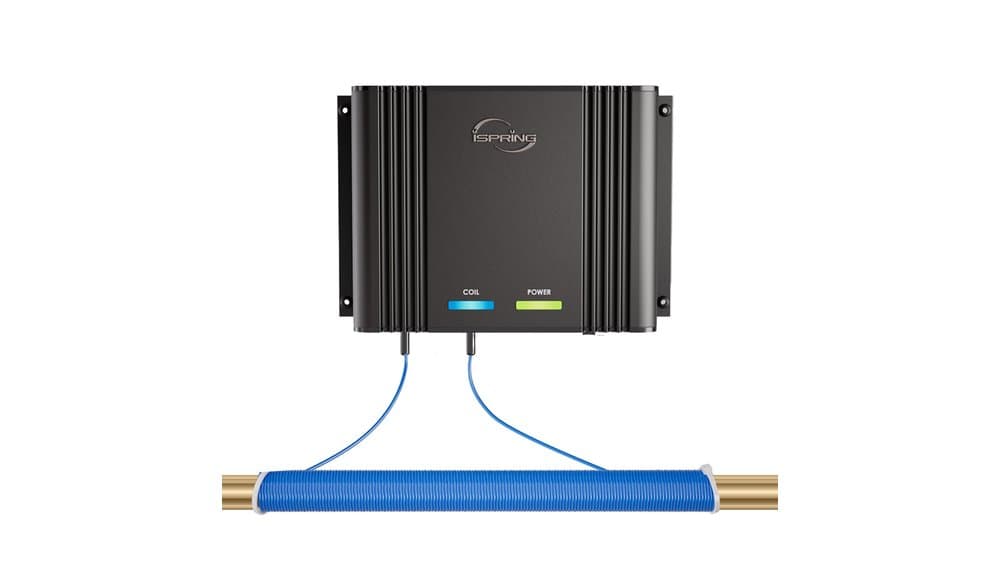
Remarkably simple installation. This is undoubtedly its most consensual advantage. The device requires no pipe cutting, no complicated connections, and therefore does not require the services of a plumber. It attaches mechanically to the main water supply pipe, typically at the home's entry point. Its compact size (35 x 60 x 15 cm) allows it to fit in tight spaces, like under a sink or in a utility room.
Zero maintenance and eco-friendly operation. Unlike a salt-based water softener which requires regular refilling of salt pellets and generates a brine discharge loaded with sodium, the EDV2 runs on battery (with an advertised lifespan of several years) and does not alter the chemical composition of the water. There are no consumables to replace, eliminating a recurring annual cost. This absence of ionic modification is presented as a health advantage, as natural minerals like calcium and magnesium are preserved.
Preventive action on appliances. The main sought-after benefit is the protection of household appliances (water heater, washing machine, dishwasher, coffee maker) and pipes against new limescale buildup. In theory, this should translate to extended equipment lifespan, reduced energy consumption, and less need for descaling products.
Weak Points
However, an honest analysis must acknowledge the inherent limits of this technology, which are often a source of misunderstanding or disappointment.
It does NOT soften water. This is the most crucial point to understand. The iSpring EDV2 is an electronic conditioner, not a softener. It does not remove the calcium and magnesium ions responsible for water hardness (TH). Your water will therefore remain just as "hard" coming out as going in. Testers emphasize that this means the tactile sensation and taste of the water are not changed as with a traditional softener.
Variable and gradual effectiveness. Its action is preventive and limited curative. If solid, old scale deposits are already present in your pipes, the EDV2 will not aggressively dissolve them. Over time, it can contribute to gradually breaking them down. The most visible results concern preventing new deposits on heating elements, but it can take several weeks (up to 12 according to the manufacturer) to fully manifest.
No filtration of contaminants. This product must not be confused with a purification system. The iSpring EDV2 eliminates no contaminants: neither chlorine, heavy metals, nitrates, PFAS, microplastics, nor bacteria. Its scope of action is exclusively limescale, and in a particular form (crystallization). To obtain purified water, it must be paired with an appropriate filtration system (activated carbon filter, reverse osmosis, etc.).
Detailed Analysis: Technology and Real-World Efficacy
To understand what can be expected from the iSpring EDV2, one must delve into its operating principle and compare it to other market technologies.
How does the EDV2 work?
The device generates a variable high-power electromagnetic field (advertised as 10 times more powerful than conventional models) around the pipe on which it is installed. This field acts on the minerals responsible for hardness (calcium and magnesium carbonates) by altering their crystallization process. Instead of precipitating as hard, adherent calcite (scale), they tend to form aragonite, a less adherent crystalline form that remains suspended in the water and is flushed away with the flow. This mechanism explains both the preventive effect (no new deposit) and the slow curative effect (old deposits, weakened, are gradually eroded by the water flow).
Comparison with other technologies
- Salt-Based Softener (ion exchange): This is the reference for removing hardness. It physically removes calcium and magnesium ions by exchanging them for sodium or potassium ions. It produces "soft" water, intensely protects installations, but alters water taste, requires regular maintenance (salt, regeneration), a drain connection, and generates sodium-rich wastewater. The EDV2 is an alternative for those who refuse these constraints.
- Filtration (Activated Carbon, Reverse Osmosis): These technologies address a different need: removing contaminants for drinking water quality. Reverse osmosis, for example, effectively removes a very wide range of pollutants (heavy metals, nitrates, PFAS, etc.) and also significantly reduces hardness, but with limited flow, significant water waste, and a cost in consumables (membranes, pre-filters). The EDV2 can be installed upstream of a reverse osmosis system to protect its membrane from clogging due to limescale; this is a smart combination.
- UV Treatment: Exclusively for bacteriological disinfection, it is complementary and not comparable.
The verdict on real-world efficacy: According to community feedback and expert analyses, the iSpring EDV2 positions itself as an effective installation protector for water of medium hardness. It performs well in reducing the formation of new scale, which translates to cleaner heating elements in kettles or water heaters, and reduced need for descaling appliances. Its effectiveness is deemed satisfactory and often superior to other low-end electronic conditioners, thanks to its claimed power. However, for extremely hard water and pre-existing severe scaling problems, its action may be perceived as insufficient.
Technical Specifications
The table below summarizes the key characteristics of the iSpring EDV2, essential for evaluating its compatibility with your installation.
| Characteristic | iSpring EDV2 Specification |
|---|---|
| Technology | Electronic Conditioning / Electromagnetic Field |
| Targets | Limescale (prevention and reduction of existing deposits) |
| Contaminants Removed | None. Does not filter chlorine, heavy metals, nitrates, PFAS, microplastics, bacteria. |
| Hardness (TH) Modification | No. The calcium/magnesium level remains identical. The water is not softened. |
| Water Flow Rate | Unlimited. Does not affect pressure or flow. |
| Waste Rate | 0%. Does not generate wastewater. |
| Annual Consumable Cost | €0. Runs on long-life battery (several years). No filters to change. |
| Power Supply | 2 D-cell batteries (not included). Advertised lifespan up to 2 years. |
| Pipe Compatibility | All types (Copper, PEX, PVC, Steel, Lead). Recommended diameter: 10 to 35 mm. |
| Max. Supported Hardness | Up to 500 ppm (parts per million) or approximately 28 °f (French degrees). |
| Dimensions (L x H x D) | 60 x 35 x 15 cm (main body + clamps) |
| Installation | Simple attachment to pipe. No cutting, no plumber needed. |
| Warranty | 1-year limited after registration. |
What Users and Testers Say
The synthesis of hundreds of online reviews paints a nuanced but overall positive consensus, provided expectations are properly calibrated.
Recurring positive points:
- Installation Simplicity: This is the most unanimously praised point. "Installed in 10 minutes," "no plumbing skills necessary," "very discreet under the sink."
- Observable Effects on Appliances: Many users report clear improvement after a few weeks: "No more white residue in the kettle," "the washing machine is quieter, fewer marks on the drum," "the water heater element seems cleaner."
- Sensation on Skin and Hair: Although the water remains chemically hard, several note less dry skin after showering and hair that is easier to manage, attributing this to a change in the structure of the limescale.
- Reliability and Lack of Maintenance: "It works on its own," "no refills to worry about," "the battery lasts a long time." The robustness of the aluminum alloy construction is also mentioned.
Points of caution and criticisms:
- Misunderstood Expectations: Disappointments often stem from a lack of product knowledge. "The water still tastes the same," "the hardness test shows the same result" – these are criticisms targeting an objective (softening) that the product does not claim to achieve.
- Effectiveness on Old Scale: For heavily scaled installations, the effects are slow and sometimes imperceptible. "Nothing changed on my old faucets," "a chemical descaling will probably be needed beforehand."
- Delay in Action: Improvement is not immediate. It generally takes 4 to 8 weeks to see significant results, which the manufacturer also indicates.
Technical testers confirm this profile: the iSpring EDV2 is considered one of the best-designed and most powerful electronic conditioners on the consumer market. Its preventive efficacy is judged very adequate, but they all remind that it will never replace a salt softener in a region with very hard water for solving acute problems (irritated skin, rapid scaling).
Conclusion
The iSpring EDV2 Electronic Descaler Anti-Limescale System is a product that finds its place in a very specific niche. It is not a universal miracle solution, but a pertinent tool for a targeted problem.
We recommend it to all households seeking a simple, ecological, and maintenance-free solution to protect their installations and household appliances from limescale, without wanting to invest in a salt-based softener with its installation, maintenance, and water modification constraints. It is particularly suited for homes with PEX or PVC piping, where installing a classic softener is more complex, and for water of low to medium hardness.
On the other hand, it should be ruled out if your main goal is to obtain truly softened water (for reasons of intense skin comfort or taste), or if you need to eliminate specific contaminants from your water. In the latter case, it could potentially serve as a first stage of "pre-treatment" to protect a more sophisticated filtration system, like a reverse osmosis unit.
Its value for money is judged in the long term: the initial investment is offset by the absence of recurring costs and potential savings on energy and appliance lifespan. If your expectations are aligned with its real capabilities – an effective and passive scale inhibitor – then the iSpring EDV2 constitutes a logical and satisfying choice in the ecosystem of domestic water treatment.
100% free and independent — All our articles are written independently, without any sponsorship. We may earn a commission on purchases made through our links, at no extra cost to you.
Articles you might like
Alkaline Water Ionizer 11-Plate Electrode Test
Analyzes the 11-plate alkaline water ionizer: Does it filter water effectively, alter its properties, and deliver promised health benefits for a family?
TOODO Fleck 5800 SXT Monobloc Water Softener Review
Volumetric TOODO Fleck 5800 SXT water softener eliminates limescale efficiently for families. A review of features & performance.
Ecoviva E6 Reverse Osmosis Water Filter Review
Compact, tankless Ecoviva E6 reverse osmosis system analyzed. We test its real-world purification performance, health benefits, and home integration.
Guides you might like
Alkaline Water Ionizer Buying Guide
Discover how alkaline water ionizers work and learn key tips to choose the right one for your home and health. Essential buying guide.
Buying Guide: Best Hydrogen Water Generator
Guide to hydrogen water generators: cutting through the hype to help you make an informed purchase decision for your health and budget.
Choosing Your Home Water Filter
Unlock clean, tasty water at home. Find the right water filter to tackle chlorine, pollutants, and limescale for better health and peace of mind.