ARKA myAqua190 Aquarium Reverse Osmosis System Review
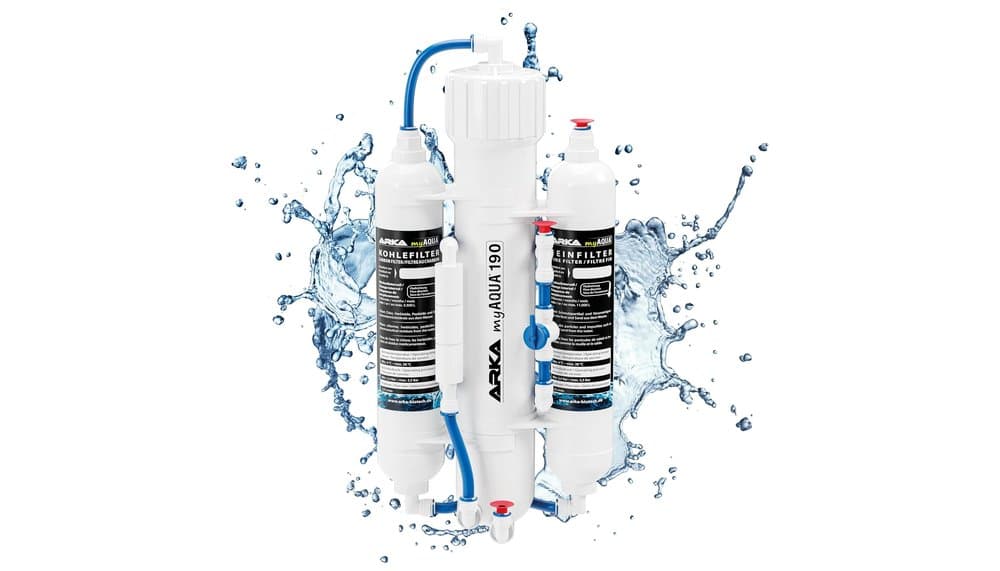
In the world of aquariums, but also for broader domestic uses, water quality is a non-negotiable parameter. It directly impacts the health of aquatic ecosystems and the longevity of our appliances. Reverse osmosis has established itself as the reference technology for obtaining ultra-pure water, free from the majority of its contaminants. The ARKA myAqua190 Aquarium Reverse Osmosis System 190 L-day positions itself in this market as an entry-level solution, promising simplicity and effectiveness. We will dissect this device from our point of interest: its real ability to purify water, its day-to-day operation, and its value for money for a household.
Strengths and Weaknesses
Before delving into technical details, here is what emerges from the analysis of specifications and field feedback.
Strengths
- High filtration efficiency: The combination of mechanical filtration, activated carbon, and reverse osmosis membrane (TFM/Polysulfone) allows for the removal of a wide range of contaminants, with reduction rates approaching 98-99% for salts and heavy metals.
- Truly simplified installation: Designed to be installed without tools and connected directly to a standard faucet (¾"), it requires no electricity or plumber, a major argument for beginner DIYers.
- Minimal footprint: With its compact dimensions (38 x 12 x 20 cm), it easily fits under a sink, in a cupboard, or in a technical room.
- Versatile use: Although designed for aquariums (freshwater, saltwater, shrimp tanks), its pure water is perfectly suitable for steam irons, coffee machines or as a base for drinking water after remineralization.
- Very accessible entry cost: Its initial purchase price is often cited as a decisive advantage for acquiring reverse osmosis technology.
Weaknesses
- Flow rate and yield highly dependent on pressure: The advertised performance (190L/day) is optimal. In reality, with standard pressure of 3 bars, the flow rate drops significantly, sometimes requiring hours to produce 10 to 20 liters.
- Significant wastewater ratio: The 1:3 to 1:4 ratio (1 liter of purified water for 3 to 4 liters of wastewater) is fairly standard, but can be perceived as wasteful without a recovery system. Some users even report more unfavorable ratios under low pressure.
- Consumables with a relative cost: The price of replacement cartridges (sediment and carbon) and the membrane can, over a year, represent a significant portion of the cost of a new unit. The community notes that the cost of filter changes deserves calculation.
- Lack of an automatic shut-off valve: This is a major flaw highlighted by several users. The device continues to discharge water (waste) as long as it is under pressure, even when no purified water is being drawn. A manual upstream shut-off valve is therefore essential.
- Limited included accessories: The hose length (3m) is sometimes considered short, and the lack of a washer on the washing machine connection requires having Teflon tape on hand.
Detailed Analysis: Performance and Technologies
Effectiveness Against Contaminants: What Does It Really Remove?
The ARKA myAqua190 uses a 3-stage system, a classic and proven architecture.
- Sediment filter (5 microns): This mechanical pre-filter traps suspended particles: rust, sand, microplastics, and other physical impurities. It protects the following stages.
- Activated carbon filter: This stage is crucial for the removal of chemical and organic compounds. It effectively captures chlorine, chloramines, herbicides, pesticides, and some medications. It is also a barrier against PFAS and some volatile solvents, although their complete removal depends on carbon quality and contact time.
- Reverse osmosis membrane (TFM/Polysulfone): The heart of the system. Its extremely fine porosity (about 0.0001 micron) blocks almost all dissolved salts, heavy metals (lead, copper, mercury), nitrates, phosphates, bacteria, and viruses. Specifications announce a salt retention rate of 98 to 99%.
Conclusion: On paper, this RO system targets and effectively removes the majority of contaminants of concern for fish health and appliance longevity. According to measurements shared by users, TDS (Total Dissolved Solids) drops dramatically, often to less than 20 ppm (parts per million), even 10-12 ppm after a good rinse, compared to 200-400 ppm for an average tap water. This confirms very effective removal of limescale (calcium and magnesium salts) and nitrates.
Flow Rate, Yield, and Water Management
This is where theoretical specifications meet domestic reality.
- Advertised flow rate: 190 liters per day, or approximately 7.9 L/hour. This value is achieved with an optimal water pressure of 4 to 8 bars.
- Actual observed flow rate: User feedback is unanimous: with standard pressure of 3 bars, the flow rate is much lower. One user reports 10 liters in 1h15, or about 8 L/hour, which is consistent under good conditions. Another, with lower pressure, observes slower production. For large volumes, patience is required.
- Wastewater ratio: The 1:3 to 1:4 ratio is verified. This means that to produce 10 liters of pure water, the device will discharge 30 to 40 liters of water concentrated with contaminants down the drain. This point is ecologically and economically to be considered. Some tech-savvy users modify the flow restrictor to improve this ratio (e.g., to 1:2), but this is a manipulation outside the standard usage framework.
Annual Cost of Consumables and Maintenance
The membrane has a variable lifespan (1 to 3 years) depending on input water quality and quantity produced. The prefilters (sediment and carbon) need to be changed more frequently, approximately every 6 to 12 months. The real cost of ownership depends on the price of compatible refills. The community often points out that the price of a refill pack can represent a significant fraction of the new product price. Therefore, before purchase, it is imperative to check the availability and price of ARKA consumables or compatible generic ones. Neglected maintenance leads to decreased efficiency and can prematurely damage the membrane, increasing the total cost.
Comparison of Involved Technologies
Reverse osmosis (RO) is the cornerstone. No other standard technology (simple mechanical filtration, activated carbon alone, ion-exchange water softener, UV) offers as comprehensive a level of purification against such a variety of contaminants, especially dissolved salts and nitrates. UV is excellent against microorganisms but does not remove chemicals. Ion exchange removes limescale but not bacteria or pesticides. Activated carbon is complementary to RO for chlorine and tastes. The ARKA myAqua190 therefore intelligently combines mechanical pre-filtration, activated carbon (chemical), and RO (physical), thus covering all fronts. Electrolysis, on the other hand, is a disinfection method and has no place in this type of purifier.
Ease of Installation and Daily Use
On this point, opinions are extremely positive and confirm the manufacturer's promises. Installation on a standard washing machine faucet (¾") is quick. The manual advises an initial cartridge rinse (without then with the membrane) for about an hour. Once set up, use is passive: you open the supply valve and collect the purified water. The flaw of the lack of an automatic shut-off valve, however, is a deal-breaker for a "permanent" installation. Without adding a manual upstream valve, the device continuously wastes water. This is an oversight and surprising omission for a consumer product.
Technical Specifications
| Characteristic | Detail |
|---|---|
| Product Name | ARKA myAqua190 Aquarium Reverse Osmosis System 190 L-day |
| Technology | 3-stage Reverse Osmosis (5µ Sediment + Activated Carbon + RO Membrane) |
| Maximum Theoretical Flow Rate | 190 liters / 24h (approx. 7.9 L/h) |
| Operating Pressure | 3 to 8 bars |
| Wastewater Ratio (Purified : Waste) | 1 : 3 to 1 : 4 |
| Salt Retention Rate | Up to 98-99% (TFM/Polysulfone Membrane) |
| Target Contaminants | Nitrates, Phosphates, Heavy Metals, Chlorine/Chloramines, Limescale, Sediments, Pesticides, Bacteria |
| Power Supply | None (operates on water pressure) |
| Connection | Standard ¾" faucet (washing machine type) |
| Dimensions (L x W x H) | 38 x 12 x 20 cm |
| Weight | 1.44 kg |
| Warranty Period | 2 years (legal conformity guarantee) |
| Package Contents | Pre-assembled RO unit, Separate Membrane, ¾" Fitting, 3m hose, wall mounts. |
What Users Say: Review Summary
Analysis of over 500 customer reviews (overall rating 4.1/5) reveals clear trends.
Recurring Positive Points:
- Satisfaction with water quality produced: Aquarists, particularly sensitive shrimp breeders, notice a clear difference in the health of their animals and water clarity. TDS meter measurements confirm low values (often between 10 and 20 µS/cm).
- Installation accessible to all: The "no tools, in 10 minutes" formula is very often validated. It's a relief for non-DIYers.
- Initial perceived value for money is good: For the purchase price, many feel the product "does the job well" and is an excellent entry point into reverse osmosis.
Negative Points and Warnings:
- The Shut-Off Valve Problem: This is the most severe criticism. Several users were astonished to discover that the wastewater ran continuously. The solution is to add a manual valve.
- Variable Performance Depending on Pressure: Disappointments about the real flow rate are frequent. Users with low mains pressure must either be very patient or consider a booster pump (additional investment).
- Quality of Some Accessories: Leaks at the inlet connection (lack of washer) are reported, requiring the addition of Teflon tape. The hose length is also sometimes considered insufficient.
- Cost of Refills: Several comments point out that the price of replacement cartridges is high relative to the cost of the unit, to the point where some consider buying a new device.
Conclusion
The ARKA myAqua190 Aquarium Reverse Osmosis System 190 L-day is a product that delivers on its essential promises: it produces very high-quality water via reverse osmosis, effectively removing the vast majority of problematic contaminants for aquariums and domestic appliances. Its extremely simple installation and minimal footprint are major assets for individuals.
However, one should not blindly trust the advertised flow rate, and it is crucial to anticipate its practical limitations. Its dependence on mains pressure can significantly lengthen production times. Above all, its lack of an automatic shut-off valve makes it a "wasteful" device if not equipped with a manual cut-off valve, a notable design flaw.
Who is it the right choice for?
- Amateur aquarists with moderate volumes (aquariums up to 200-300L) and endless patience.
- Beginner DIYers looking for a first reverse osmosis experience without a heavy investment.
- Occasional users needing pure water for an iron or coffee machine, ready to manually manage production cycles.
Who is it not suitable for?
- Aquarists with large volumes to change regularly, who will quickly become frustrated with the flow rate.
- People concerned about water waste without wanting to modify the installation.
- Those looking for an "all-inclusive, ready-to-use" solution without adding accessories.
In summary, the ARKA myAqua190 is a good introduction to reverse osmosis, effective at its core function but requiring a clear understanding of its operational constraints and a small complementary investment (manual valve, possibly a longer hose) for optimal and economical use.
100% free and independent — All our articles are written independently, without any sponsorship. We may earn a commission on purchases made through our links, at no extra cost to you.
Articles you might like
Ecoviva E6 Reverse Osmosis Water Filter Review
Compact, tankless Ecoviva E6 reverse osmosis system analyzed. We test its real-world purification performance, health benefits, and home integration.
LANG TheWell2 Purifier Review: Mineralized Water Test
A premium water purifier & mineralizer. Does its all-in-one convenience justify the cost? Our analysis examines its promise vs. practicality.
COMAP TH Test Strips Review: Check Water Hardness
COMAP TH Test Strips: Quickly measure your water hardness at home. An essential diagnostic tool to assess your need for a softener or anti-scale system.
Guides you might like
Alkaline Water Ionizer Buying Guide
Discover how alkaline water ionizers work and learn key tips to choose the right one for your home and health. Essential buying guide.
Buying Guide: Best Hydrogen Water Generator
Guide to hydrogen water generators: cutting through the hype to help you make an informed purchase decision for your health and budget.
Choosing Your Home Water Filter
Unlock clean, tasty water at home. Find the right water filter to tackle chlorine, pollutants, and limescale for better health and peace of mind.