ARKA myAqua380 Reverse Osmosis System Review
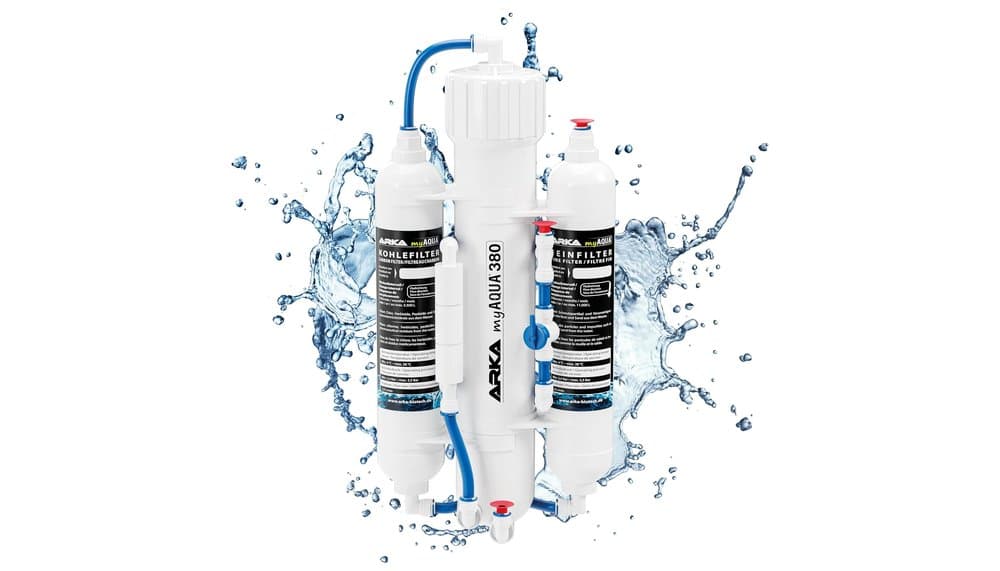
Analysis of the ARKA myAqua380: Can Reverse Osmosis Purify Everything for Your Aquarium?
In the world of aquariums, water quality is not a simple preference, it is an absolute necessity for the health of fish, plants, and invertebrates. Tap water, even of good quality for us, is often a cocktail of substances harmful to a closed ecosystem. Reverse osmosis has established itself as the reference technology for producing "neutral" water, a blank canvas on which the aquarist can build their perfect biotope. The ARKA myAqua380 Aquarium Reverse Osmosis System promises to do this efficiently, simply, and with a generous flow rate. But how does it really stack up against technical and practical requirements? This is what we will break down.
Strengths
- Complete and Effective Filtration: Extensive removal of key contaminants, from nitrates to heavy metals.
- Practical Flow Rate and Compact Size: 380 liters per day allows for quickly filling reserves, all in a modular and compact format.
- Truly Simplified Installation: Designed to be installed without tools and without a plumber, a major asset for beginners.
- Versatile Use: Beyond the aquarium, it protects household appliances sensitive to limescale.
Weaknesses
- Dependence on Network Pressure: Without sufficient water pressure, performance drops drastically.
- A Waste Water Ratio to Monitor: Like any reverse osmosis system without a booster pump, it consumes more water than it produces.
- Mandatory Regular Maintenance: The cost and frequency of consumables are a factor to include in the long-term budget.
Detailed Analysis: Water Health and Technologies Under the Microscope
Which Contaminants Does It Really Remove?
The technical sheet for the ARKA myAqua380 announces removal of up to 99% of several families of pollutants. On paper, this covers the spectrum most dangerous for an aquarium.
- Chlorine and Chloramines: Effectively neutralized by the activated carbon cartridge upstream. This is a basic but vital function, as these disinfectants directly kill aquatic fauna and flora, as well as beneficial bacterial biology.
- Heavy Metals (lead, copper, etc.) and Nitrates/Phosphates: These are the major strengths of reverse osmosis. The semi-permeable membrane, the heart of the system, effectively blocks these molecules. For reef or very sensitive aquariums, this is essential. It helps combat unwanted algae and organism stress.
- Limescale (Calcium and Magnesium): Reverse osmosis is a radical softener. It removes total hardness (GH) and carbonate hardness (KH), producing very soft water. This is ideal for Amazonian freshwater fish (Discus, Tetras) or for reconstituting precise synthetic seawater. For other biotopes, remineralization will be necessary afterward.
- Suspended Particles and Turbidity: The 5-micron sediment pre-filter retains microplastics, dust, and sludge, thereby protecting the membrane.
- Pesticides and PFAS (perfluoroalkyl substances): According to expert tests, a good quality reverse osmosis membrane like the one supplied can remove a very large portion of these persistent organic pollutants, although the exact rate depends on the molecule.
In summary, this 3-stage system (mechanical, chemical, osmosis) logically combines technologies to cover the majority of threats. UV technology or specific ion exchange are not present here, which is consistent for its market. Reverse osmosis remains the most comprehensive technology for "deep" purification.
Flow Rate, Reject Water, and Practical Specifications
Here are the key data, summarized for quick analysis:
| Parameter | Value / Characteristic |
|---|---|
| Production Flow Rate | Up to 380 liters of RO water per day (approx. 15.8 L/h) |
| Reject Ratio (Waste Water) | Not precisely specified, but follows the classic rule for standard pressure systems (estimated between 3:1 and 4:1, meaning 3 to 4 liters of water wasted for 1 liter produced) |
| Technologies Used | Mechanical Pre-filtration (5µm), Activated Carbon, Reverse Osmosis (TFC membrane) |
| Installation | Tool-free, quick-connect to standard 3/4" faucet, no electricity required |
| Consumables | Set of 3 replacement cartridges (sediment, carbon, membrane) |
| Parts Warranty | 2 years |
The advertised flow rate of 380L/day is more than adequate. It allows producing 20 liters in under an hour and a half, which is practical for water changes on aquariums up to 300-400 liters, or for filling a reserve tank. This is a distinguishing argument compared to "nano" models at 50 or 100 L/day.
The critical point, highlighted by the community, is the reject ratio. A reverse osmosis system works by continuously flushing out concentrated contaminants. If your water pressure is low (<3 bars), this ratio can become very unfavorable (up to 5:1 or 10:1), wasting a lot of water. This is the main ecological and economic drawback of this technology without an integrated pump. For optimal use, a pressure between 3 and 4 bars is recommended.
Annual Cost of Consumables and Maintenance
The ARKA myAqua380 is no exception to the rule: a reverse osmosis membrane is fragile and must be protected. The pre-filters (sediment and carbon) are typically replaced every 6 months, the membrane every 12 to 24 months depending on the input water quality and volume produced.
The annual cost therefore depends on the price of the replacement sets. Analyzing the market, we see that the 3-cartridge packs for this model have a cost that, over a year, represents a significant investment, often equivalent to a portion of the price of a new system over 2 to 3 years. This is a crucial element in calculating the price-performance ratio. Not performing these replacements leads to a drastic drop in performance and can irreparably damage the much more expensive membrane.
Ease of Installation and Daily Use
This is where the myAqua380 often shines in feedback. The promise of a tool-free installation in a few minutes is, according to testimonials, largely fulfilled for those with a standard faucet. The integrated wall mount and compact format are appreciated for saving space under the sink or in a technical room.
For daily household use as drinking water production, it would require the addition of a pressure tank and a remineralizing or taste post-filter, for which it is not provided as standard. Its primary use remains aquariums and protecting household appliances from limescale.
What Users Say: Summary of Feedback
Customer reviews and online discussions paint a consistent and nuanced picture of the product.
The recurring positive points are:
- Satisfaction with Water Quality Produced: Aquarists measure a radical drop in GH/KH, nitrates, and very low conductivity. The water is clear and allows for perfect parameter control.
- Simple Installation: The majority confirm that assembly is within everyone's reach, even without technical skills. The quick-connect fittings are deemed reliable.
- Appreciated Flow Rate: Those switching from a smaller model to the 380 are unanimous about the time saved filling their containers.
- Adequate Robustness: No widespread reports of leaks or breakage, a sign of satisfactory design and assembly quality.
The points of attention and criticisms noted are:
- Water Pressure, a Prerequisite: This is THE topic. In old buildings or on high floors, users report a very low flow rate, even almost no production. The solution is consistently suggested: installing a dedicated booster pump, which represents additional cost and complexity.
- Water Waste: The reject ratio is often misunderstood or underestimated. Many are surprised to see so much water "going down the drain." This is an inherent characteristic of the technology in this configuration.
- An Improvable Manual: Some feedback notes that the installation guide could be clearer, especially regarding the initial flushing sequence and cartridge order.
- Variable Quality of Replacement Consumables: Some experienced users suggest checking compatibility with third-party membranes and pre-filters from reputable brands to optimize the long-term performance/price ratio.
Conclusion: Who is the ARKA myAqua380 For?
The ARKA myAqua380 Aquarium Reverse Osmosis System is not a miracle product, but it is an effective and well-designed technical tool that fulfills its main promise: producing high-quality pure water for demanding aquariums.
Its main advantage is democratizing access to reverse osmosis through an extremely simple installation and controlled size. Its 380 liters/day flow rate makes it a relevant choice for medium to large aquariums or multiple aquarium keepers, saving them precious time.
However, its purchase should not be taken lightly. It is imperative to check your water network pressure. Without a stable minimum pressure of 3 bars, the installation will be disappointing. One must also accept the inherent principle of water waste and integrate the recurring cost of consumables into the budget.
Ultimately, we particularly recommend it to the beginner or intermediate aquarist looking for a ready-to-use solution, simple to install, and with a comfortable flow rate for their use, provided their water pressure is sufficient. For those with low pressure or wishing to optimize the reject ratio, they will need to look at systems with an integrated pump, often at a higher price. The myAqua380 thus positions itself as a smart and effective compromise in the mid-range, provided one clearly understands and accepts its fundamental technological limitations.
100% free and independent — All our articles are written independently, without any sponsorship. We may earn a commission on purchases made through our links, at no extra cost to you.
Articles you might like
Lafiucy 10 Inch Coconut Carbon Filter Review
Review of the affordable Lafiucy 5 Microns 10-inch activated carbon water filter cartridge, analyzing specs & user feedback for performance.
ALTHY Performance Hydrogen Water Bottle Review
Transform water into antioxidant-rich hydrogen water anywhere with the ALTHY portable bottle. A powerful, on-the-go wellness innovation.
Swiss Aqua Technologies IPS Kalyxx Water Softener Review
IPS Kalyxx magnetic water conditioner offers scale prevention without salt, electricity, or maintenance, using a permanent magnet.
Guides you might like
Alkaline Water Ionizer Buying Guide
Discover how alkaline water ionizers work and learn key tips to choose the right one for your home and health. Essential buying guide.
Buying Guide: Best Hydrogen Water Generator
Guide to hydrogen water generators: cutting through the hype to help you make an informed purchase decision for your health and budget.
Choosing Your Home Water Filter
Unlock clean, tasty water at home. Find the right water filter to tackle chlorine, pollutants, and limescale for better health and peace of mind.