BRITA Marella Graphite Jug Filter Review
Introduction
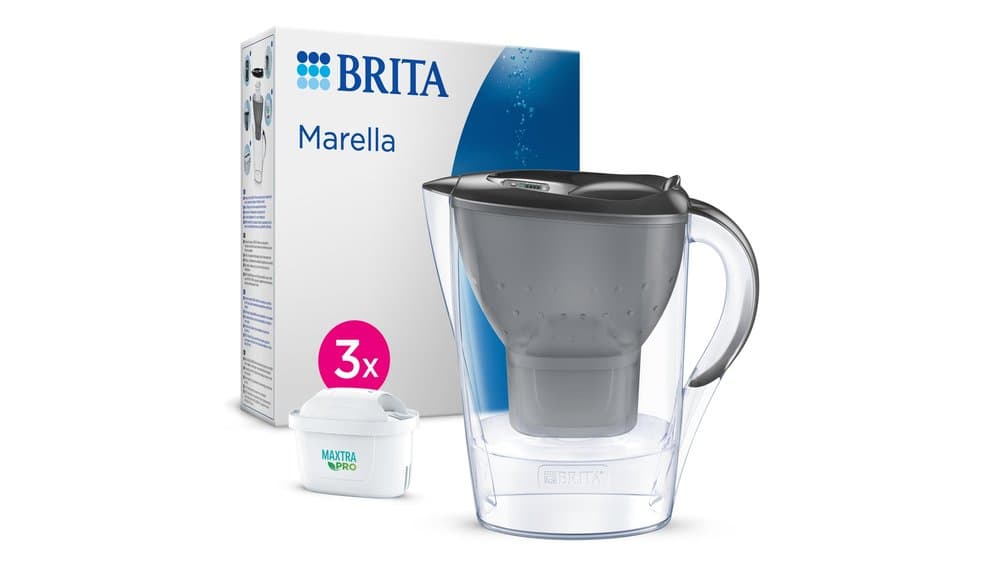
In the landscape of domestic filtration, filter jugs represent the most accessible entry-level solution. The BRITA Marella Graphite Filter Jug (2.4L) positions itself as a flagship model, equipped with the latest MAXTRA PRO cartridge technology. Here, we analyze this jug not as a simple kitchen object, but as a complete filtration system. The central question is what it can truly offer in terms of water quality and health for daily family use, and how it compares to other technologies like reverse osmosis or UV systems.
Strengths of the BRITA Marella Graphite
- Targeted and Modernized Filtration: The MAXTRA PRO cartridge is designed to reduce specific contaminants like chlorine, limescale (calcium), some heavy metals (lead, copper), and, a notable new feature, some PFAS (so-called "forever chemicals").
- Practical Everyday Design: Its design is thought out for daily use: one-handed filling thanks to a flap, ergonomic handle, spout with hygienic lid, and dishwasher-safe (except for the electronic lid).
- Simplified Maintenance Management: The integrated electronic Memo indicator on the lid provides a light reminder to change the cartridge every 4 weeks, making tracking easy without the user having to count liters.
- Balanced Capacity/Footprint Ratio: With a total capacity of 3.5 liters for about 2.4 liters of filtered water available, it offers a good volume for a family without being too bulky on a countertop.
Weaknesses and Identified Limitations
- Incomplete and Selective Filtration: This technology, based on activated carbon and ion exchange resins, has clear limits. It does not filter nitrates, salts, dissolved fluoride, viruses, or bacteria. Its action on microplastics is limited to particles larger than 30 microns, letting finer ones pass through.
- Time-Based, Not Usage-Based Indicator: The Memo indicator works on a fixed 4-week duration, regardless of the actual volume of water filtered. This can lead to waste (cartridge changed too early) or loss of effectiveness (cartridge exhausted before the reminder if consumption is high).
- Instant Flow, but Limited Processing Capacity: Unlike under-sink systems, there is no continuous "flow" in liters/hour. The user must wait for the water to percolate through the cartridge, which can create a waiting delay when a large volume is needed quickly.
- Recurring Cost of Consumables: The annual cost is directly linked to the number of cartridges used. With a change every month (or 150 liters, whichever comes first), maintenance represents an annual budget to consider.
Detailed Analysis: Performance, Health, and Technological Comparison
Which contaminants are actually removed?
According to the technical specifications and cited certifications (NSF/ANSI 53 for certain contaminants), the BRITA Marella Graphite with its MAXTRA PRO cartridge acts on several fronts:
- Taste and Odor: The reduction of chlorine is effective and constitutes its main sensory benefit.
- Water Hardness (Limescale): The ion exchange resins capture a portion of calcium and magnesium ions, slightly softening the water and limiting deposits in kettles or coffee machines. It is not a water softener, but a notable improvement for areas of medium hardness.
- Heavy Metals and Organic Contaminants: It reduces metals like lead and copper, as well as certain pesticides, herbicides, and pharmaceutical residues. The mention of PFAS reduction (like PFOA/PFOS) is a recent, weighty argument, validated by laboratory tests, addressing an emerging health concern.
Important limitations to remember: This jug is not intended to purify non-potable water. It does not remove nitrates, dissolved minerals (sodium, fluoride), or microbiological pathogens. It acts as a polisher for tap water already compliant with potability standards.
Comparison with other filtration technologies
- Vs. Reverse Osmosis: Reverse osmosis is radically more complete. It removes up to 99% of almost all contaminants (salts, nitrates, metals, bacteria, viruses, PFAS). However, its flow is slow, it wastes several liters of water for one filtered liter, requires under-sink installation often by a plumber, and its annual cost (membranes + pre-filters) is higher. The Brita Marella is a zero water waste, zero installation solution, but with much lower filtration performance.
- Vs. Stick Activated Carbon (faucet filters): The technology is similar, but the MAXTRA PRO cartridge additionally integrates ion exchange (for limescale) and a more elaborate filtration structure. It is generally more effective and convenient than small direct faucet filters.
- Vs. UV Sterilization or Electrolysis: These technologies primarily aim to disinfect (kill bacteria, viruses). They do not remove chemical contaminants or limescale. They are complementary, not comparable.
- Vs. Ion Exchange Water Softener: A water softener treats limescale for the whole house but does not filter other contaminants. The Brita offers a localized, partial solution for drinking water only.
Ease of Use and Family Value-for-Money
Installation is non-existent: you fill, wait, pour. This is its major asset. The footprint is that of a large jug. Testers note that it generally does not fit in the refrigerator door but easily fits on a shelf inside.
The value-for-money must be evaluated over time. The initial investment is modest, but the recurring cost of MAXTRA PRO cartridges adds up. For a family that mainly drinks tap water and wants to improve its taste and moderately reduce limescale and certain targeted contaminants like PFAS, the solution is economical and relevant. For a quest for absolute water purity or to treat water with specific problems (high nitrates), it will be insufficient.
Technical Specifications
| Characteristic | Detail for the BRITA Marella Graphite (2.4L) |
|---|---|
| Filtration Technology | MAXTRA PRO Cartridge: Activated Carbon + Ion Exchange Resin |
| Reduced Contaminants | Chlorine, Limescale (hardness), Heavy Metals (Lead, Copper), certain Pesticides/Herbicides, Pharmaceutical Residues, certain PFAS (PFOA/PFOS) |
| Contaminants NOT filtered | Nitrates, Fluoride, Sodium, Bacteria/Viruses, microplastics < 30µm |
| Capacity | Total: ~3.5L / Filtered: ~2.4L |
| Flow Rate / Wait Time | No continuous flow. Percolation time required. |
| Cartridge Duration/Life | 4 weeks or 150 liters (whichever comes first) |
| Replacement Indicator | Electronic Memo (time-based) |
| Installation | None (countertop placement) |
| Maintenance | Jug is dishwasher-safe (except lid with Memo) |
| Water Waste | 0% (no waste like in reverse osmosis) |
| Certifications | Reduction of certain contaminants tested per NSF/ANSI 53 and Japanese standard JWPAS B210 (for PFAS) |
What Users and Testers Say
The user community and expert tests converge on several points.
Recurring Positive Points:
- Noticeable Taste Improvement: The reduction of chlorine is unanimously praised. The water is described as softer and more pleasant to drink.
- Practical and Functional Design: The one-handed filling system and overall ergonomics are highly appreciated in daily use. The capacity is deemed sufficient for a family of 2 to 4 people.
- Effectiveness on Limescale: In concerned regions, users observe a clear decrease in deposits in kettles and glasses, confirming the action of the resins.
- Useful Electronic Reminder: Although criticized for its principle, the Memo indicator is recognized as a practical reminder for the less meticulous.
Criticisms and Points of Attention:
- Imprecise Indicator: The fact that the indicator measures time and not filtered volume is the most frequently raised negative point. Large families must change the cartridge before the signal, or risk loss of effectiveness.
- Cartridge Change: Some find the handling a bit tricky or note the presence of activated carbon in the water of the first cycles if rinsing was not sufficient.
- Filtration Limits: Informed users emphasize that it is an improvement, not a total purification, and one must be aware of what the system does not filter.
- Refrigerator Fit: The size often prevents it from being stored in the refrigerator door, a practical detail frequently mentioned in feedback.
Conclusion
The BRITA Marella Graphite Filter Jug (2.4L) is much more than a simple kitchen accessory. It is a performance supplemental filtration system within its domain, that of daily improvement of already potable tap water. Its effectiveness on chlorine, limescale, certain heavy metals, and now certain PFAS makes it a relevant and updated solution for families wishing to act on these specific contaminants.
However, our analysis confirms that one must see it for what it is: a water polisher, and not a universal purifier. Its limits regarding nitrates, microbes, or dissolved salts are inherent to its technology. Compared to reverse osmosis, it loses on pure performance but wins hands down on simplicity, lack of installation, and zero water waste.
The choice therefore boils down to the objective. If what we seek is better-tasting water, less limescale, with targeted reduction of pollutants like PFAS, lead, or pesticide residues, all without installation and with maximum ease of use, the BRITA Marella Graphite constitutes a reliable and well-designed answer. For more complex contamination problems or a quest for absolute purity, one must turn to more heavy-duty and expensive technologies.
100% free and independent — All our articles are written independently, without any sponsorship. We may earn a commission on purchases made through our links, at no extra cost to you.
Articles you might like
Lafiucy 10 Inch Coconut Carbon Filter Review
Review of the affordable Lafiucy 5 Microns 10-inch activated carbon water filter cartridge, analyzing specs & user feedback for performance.
ALTHY Performance Hydrogen Water Bottle Review
Transform water into antioxidant-rich hydrogen water anywhere with the ALTHY portable bottle. A powerful, on-the-go wellness innovation.
Swiss Aqua Technologies IPS Kalyxx Water Softener Review
IPS Kalyxx magnetic water conditioner offers scale prevention without salt, electricity, or maintenance, using a permanent magnet.
Guides you might like
Alkaline Water Ionizer Buying Guide
Discover how alkaline water ionizers work and learn key tips to choose the right one for your home and health. Essential buying guide.
Buying Guide: Best Hydrogen Water Generator
Guide to hydrogen water generators: cutting through the hype to help you make an informed purchase decision for your health and budget.
Choosing Your Home Water Filter
Unlock clean, tasty water at home. Find the right water filter to tackle chlorine, pollutants, and limescale for better health and peace of mind.