Pawfly 21 in 1 Drinking Water Test Kit Review
Introduction
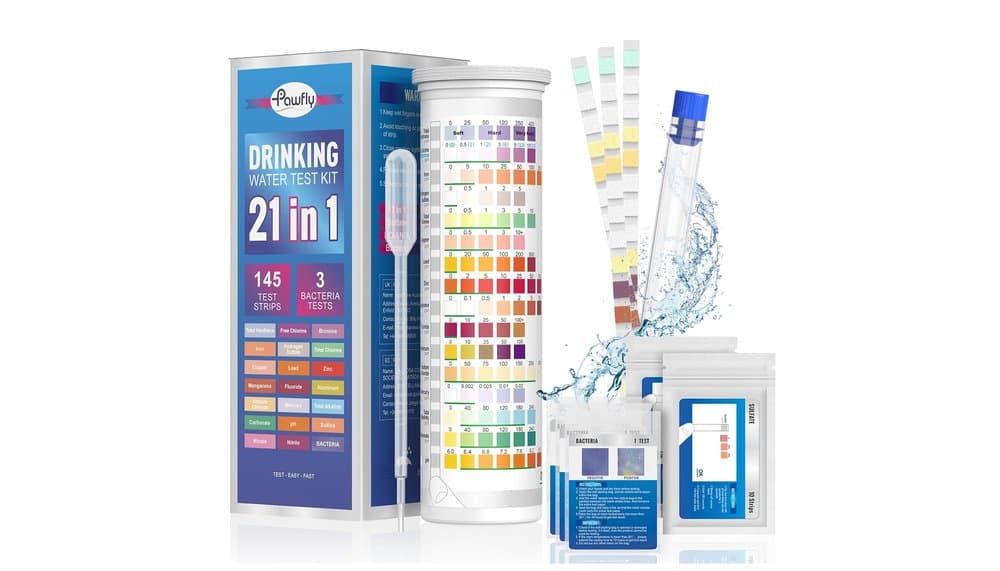
In the world of domestic water filtration, precisely knowing the composition of one's water is the fundamental first step before choosing a system. Home test products, like the Pawfly 21 in 1 Drinking Water Test Kit, promise to lift the veil on the mysteries of our tap, well, or aquarium water. This kit, presented in the form of 125 test strips, aims to offer an instant overview of 21 key parameters. For us, enthusiasts of water quality and health, the central question is: is this kit a reliable tool for guiding our filtration decisions, or does it remain a gadget with approximate results? We will dissect this product based on its specifications, feedback from the user community, and expert analysis.
Strengths and Weaknesses
Strengths
- Versatility and broad spectrum of analysis: The ability to test 21 different parameters, from chlorine to lead, including pH and hardness, makes it a very comprehensive general screening tool.
- Extreme ease of use: The process is universally recognized as simple and quick: 2-second immersion, brief wait, and comparison with a color chart.
- Favorable quantity/price ratio: With 125 strips, the kit allows for a large number of tests over an extended period, facilitating regular monitoring.
- Multiple applications: It is suitable for varied domestic use: drinking water, well water, aquarium, pool, or spa.
Weaknesses
- Limited accuracy and reliability: Test strips are notoriously less precise than laboratory analyses. The detection of specific contaminants like lead or nitrates may lack reliability, particularly at thresholds critical for health.
- Subjective interpretation: Reading the results relies on a visual comparison of colors, which can introduce interpretation error depending on lighting or individual perception.
- A detection tool, not a solution: It identifies potential problems but offers no corrective action. It does not filter a single liter of water.
- Reagent stability: Once opened, the bottle can be sensitive to humidity, which can alter the reactivity of the strips in the long term.
Detailed Analysis of the Pawfly 21 in 1 Kit
What this kit tests (and especially, what it does not test)
The Pawfly 21 in 1 covers an impressive range of parameters. For a quick analysis, it is useful for getting an idea of the general balance of your water. The tests for pH, total hardness (carbonate and non-carbonate), and free chlorine are generally the most reliable with this technology. They inform you about the aggressive or scaling nature of the water, as well as the presence of residual disinfectant.
However, we must be very clear about its limitations regarding the most concerning contaminants:
- Heavy metals (Lead, Copper, Iron): Although present on the strip, these tests are low-sensitivity qualitative or semi-quantitative indicators. They cannot confirm if levels comply with the strictest health standards. A "negative" result for lead does not guarantee its total absence.
- Nitrates/Nitrites: Useful for wells located near agricultural areas, but their reliability at levels close to legal limits is questionable.
- PFAS, Microplastics, Pesticides: Absent. These emerging and complex contaminants are not detectable by standard test strips. Their detection requires laboratory chromatography.
- Limescale: It is indirectly measured via total hardness, which is sufficient to assess the potential need for a water softener.
- Bacteria & Micro-organisms: Here again, despite the mention, these test strips are not reliable for serious microbiological analysis, which requires culture media.
In summary, this kit is an excellent tool for general monitoring and initial alert, but it must in no case be considered a complete analysis certificate or an alternative to an accredited laboratory test if you suspect serious contamination.
Comparison with active filtration technologies
It is crucial to understand the fundamental difference between detecting and removing. The Pawfly kit belongs to the first category. For the second, here is how its detection capabilities articulate with filtration solutions:
- Reverse Osmosis (RO): An RO system effectively removes almost all contaminants the kit attempts to detect (heavy metals, nitrates, salts, some microorganisms). The kit could be used to verify the efficiency of the membrane by comparing tap water and RO water. If the test still shows the presence of metals or nitrates after filtration, it would indicate a need to change the membrane.
- Activated Carbon: Very effective against chlorine, bad tastes, odors, and some organic compounds. The kit's chlorine test is perfect for validating the performance of an activated carbon cartridge.
- Ion Exchange (Water Softener): Targeted at removing calcium and magnesium ions responsible for limescale. The kit's hardness test is the ideal tool for setting and controlling the efficiency of a water softener.
- UV and Electrolysis: These disinfection technologies act on microorganisms, which the Pawfly strips cannot reliably quantify.
Thus, the kit finds its true value as a diagnostic and maintenance control tool for your existing filtration systems, much more than as a definitive initial analysis tool.
Ease of use and integration into your routine
On this point, feedback is unanimous: the kit is childishly simple. No technical skill is required. Its minimal size (a small bottle) allows it to be stored in a kitchen drawer for occasional testing. For a family, it allows for quick checks, for example:
- Before and after installing a new filter.
- During a change of season for well water.
- To monitor water quality in an aquarium.
Technical Specifications
| Parameter | Detail |
|---|---|
| Product Name | Pawfly 21 in 1 Drinking Water Test Kit |
| Product Type | Test strips |
| Number of Tests | 125 strips |
| Parameters Tested | pH, Total Hardness, Carbonate Hardness, Alkalinity, Free Chlorine, Total Chlorine, Nitrate, Nitrite, Lead, Iron, Copper, Sulfate, Fluoride, Manganese, and 7 other parameters (microorganisms, etc.) |
| Reading Time | About 15 seconds (60 seconds for nitrates/nitrites) |
| Applications | Tap water, well, aquarium, pool, spa |
| Shelf Life | Not specified (sensitivity to humidity after opening) |
| Annual Consumable Cost | None (single kit). The cost is the purchase price of the kit divided by its duration of use. |
What Users and Experts Say
The synthesis of customer reviews and available technical analyses paints a clear consensus.
The recurring positive points revolve around ease of use and informativeness. Users appreciate the speed of the test and the sense of control it provides. Many find it useful for checking the efficiency of a filter (like Brita or others), as mentioned by a user who employed it for this purpose. The quantity of strips is also seen as a good point, allowing testing at different times.
The negative points and doubts concern almost exclusively the reliability of results. Several testers point out inconsistencies. One review is particularly revealing: a customer tested tap water and the same water filtered by a Brita pitcher, and obtained identical results, leaving them confused about the efficiency of their filter or the reliability of the kit. Industry experts remind that these kits provide an indication, not a laboratory measurement. They warn against too literal an interpretation of results for contaminants like lead. Color reading can be subtle and a source of error. Finally, the stability of the strips over time is regularly cited as a point of vigilance; results may be less reliable if the bottle remains open for a long time.
Conclusion
The Pawfly 21 in 1 Drinking Water Test Kit is a practical and accessible tool for anyone wanting to get a quick and general overview of their water quality. Its true power lies in monitoring variations and the routine control of existing filtration systems (checking chlorine after activated carbon, hardness after a softener).
However, we must temper its role. It does not constitute a definitive medical or sanitary diagnostic tool. If you have serious doubts about the presence of lead, high-concentration nitrates, or any other specific contaminant, a certified laboratory analysis remains essential. Similarly, it is completely unsuitable for detecting complex pollutants like PFAS or microplastics.
Our verdict: Buy this kit if you are looking for a first indicator and a simple way to monitor the effectiveness of your filters. Consider it a thermometer that tells you if it's hot or cold, not a complete medical scanner. For any well-founded health concern, invest in a professional analysis. Used wisely, the Pawfly kit is a useful and economical ally in the quest for better-controlled domestic water.
100% free and independent — All our articles are written independently, without any sponsorship. We may earn a commission on purchases made through our links, at no extra cost to you.
Articles you might like
Lafiucy 10 Inch Coconut Carbon Filter Review
Review of the affordable Lafiucy 5 Microns 10-inch activated carbon water filter cartridge, analyzing specs & user feedback for performance.
ALTHY Performance Hydrogen Water Bottle Review
Transform water into antioxidant-rich hydrogen water anywhere with the ALTHY portable bottle. A powerful, on-the-go wellness innovation.
Swiss Aqua Technologies IPS Kalyxx Water Softener Review
IPS Kalyxx magnetic water conditioner offers scale prevention without salt, electricity, or maintenance, using a permanent magnet.
Guides you might like
Alkaline Water Ionizer Buying Guide
Discover how alkaline water ionizers work and learn key tips to choose the right one for your home and health. Essential buying guide.
Buying Guide: Best Hydrogen Water Generator
Guide to hydrogen water generators: cutting through the hype to help you make an informed purchase decision for your health and budget.
Choosing Your Home Water Filter
Unlock clean, tasty water at home. Find the right water filter to tackle chlorine, pollutants, and limescale for better health and peace of mind.