Naturewater NW-PR103 Water Filter Test & Review
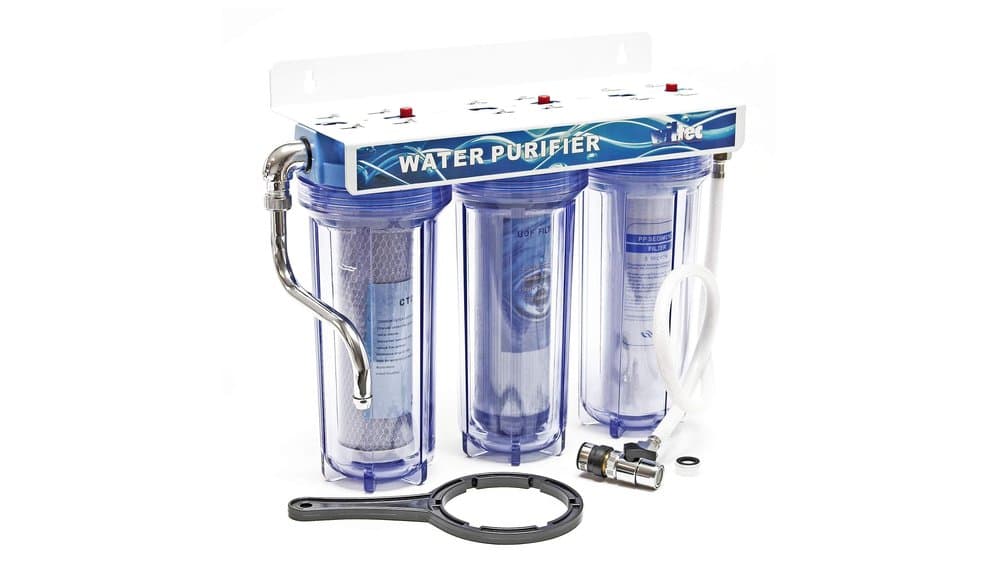
Introduction
Faced with a plethora of filtration solutions, it can sometimes be difficult to find one's way. The Naturewater NW-PR103 Drinking Water Filter presents itself as a three-stage filtration system, aimed at improving tap water quality for domestic use. We will dissect this product from our perspective of interest: its real effectiveness on health and water purity, its practical operation, and its value for money for a family. This analysis is based on a meticulous study of the manufacturer's technical specifications, user community feedback, and available expert reviews online.
Strengths and Weaknesses
Before diving into the details, here is a synthetic overview of the NW-PR103's strengths and limitations, as they emerge from the collected data.
Strengths:
- Broad-spectrum filtration: Combination of three stages (sediment, activated carbon, ultrafiltration) targeting particles, chlorine, bad tastes, and bacteria.
- High flow rate: A nominal flow rate of 600 liters per hour allows for daily use without a noticeable drop in pressure.
- Mineral retention: The absence of a reverse osmosis membrane preserves calcium and magnesium naturally present in the water.
- Modular installation: Compatibility with standard 10-inch (254 mm) cartridges, offering some freedom in the choice of consumables.
- Initial value for money: Considered a competitive product compared to more complex or expensive systems.
Weaknesses:
- Limited effectiveness on certain contaminants: Does not significantly reduce hardness (limescale), nitrates, fluorides, or PFAS.
- Recurring cost of consumables: Requires regular cartridge replacement, incurring an annual budget.
- Risk of neglected maintenance: A saturated cartridge can become ineffective or even counterproductive.
- Non-trivial installation: Requires cutting the water line and basic plumbing skills, despite the use of standard fittings.
- Component durability: Some feedback points to potential fragility of plastic purgers and a risk of cracking in case of freezing.
Detailed Analysis of the Naturewater NW-PR103
Water Quality and Health: What is the real effectiveness?
The heart of the debate for a filtration system. The NW-PR103 relies on three-stage filtration. Let's analyze each promise.
Targeted contaminants and effectiveness:
- Sediments, rust, algae: The first cartridge (5 microns) is very effective for these suspended particles. It's reliable basic mechanical filtration.
- Chlorine, bad tastes and odors, pesticides: The activated carbon stage (block and granular) is the major asset. According to specifications and user feedback, it effectively removes chlorine, radically improving the water's taste and smell. Its action on certain pesticides and organic compounds is real, but its total effectiveness depends on the carbon quality and its saturation rate.
- Bacteria, cysts, protozoa: The third stage, a 0.22-micron ultrafiltration membrane, is a serious sanitary asset. It acts as a physical barrier against pathogenic microorganisms, making it interesting for sometimes questionable water networks or rural areas.
- Heavy metals (lead, copper): The specs announce a reduction. This is typical of quality activated carbon action, which can adsorb part of these metals. However, it is not a total and guaranteed elimination like a reverse osmosis system would achieve.
Contaminants NOT treated or poorly treated:
- Limescale (water hardness): The system does not alter hardness. It may retain some suspended particles, but the calcium and magnesium ions responsible for scale pass through. It is not a water softener.
- Nitrates, Fluorides, Dissolved salts: Ineffective. These ionized contaminants require ion exchange or reverse osmosis technology.
- PFAS (forever chemicals), Pharmaceutical residues: The effectiveness of standard activated carbon on these complex molecules is limited and variable. For PFAS, specific activated carbons or reverse osmosis are recommended.
- Microplastics: The 0.22-micron membrane is capable of retaining most microplastics, which are generally larger in size. This is therefore an indirect strength of this system.
Conclusion on health: The NW-PR103 is a robust drinking water enhancer. It makes water more pleasant (taste, smell, clarity) and safer from a microbiological standpoint. However, it does not transform the deep chemical composition of the water. For a family seeking to eliminate chlorine and protect against bacterial risks while retaining minerals, it is a good choice. For treating very hard water or water contaminated with nitrates, it is insufficient.
Technical Performance and Daily Use
Flow rate and pressure: With 600 L/h, the flow rate is more than sufficient for a kitchen faucet. Testers emphasize that there is no perceptible drop in pressure, unlike reverse osmosis systems which often require a pressure pump and a storage tank. This is a decisive advantage for smooth usage.
Size and installation: Its dimensions (39.5 x 15.5 x 36 cm) require sufficient space under the sink. The installation is described as "simple" for a skilled DIYer, as it uses standard fittings (3/4" or 1/2"). However, it requires cutting the main water line and drilling the sink for a dedicated faucet if desired. The community notes that this is not a "plug-and-play" system and that a plumber's intervention can be reassuring for the less handy.
Long-term cost and maintenance: This is the critical point of all cartridge systems. The NW-PR103 does not have a usage meter. The replacement frequency therefore depends on the input water quality and volume consumed. Experts suggest a change every 6 to 12 months for stages 1 and 2, and potentially longer for the UF membrane. The annual cost of consumables is variable. Taking standard medium to high-quality cartridges as a reference, a family can expect an annual budget between €30 and €80. It is imperative to adhere to these changes, otherwise the filter risks becoming a breeding ground for bacteria.
Technology Comparison
Where does the NW-PR103 stand in the filtration landscape?
- Vs. Simple Activated Carbon (faucet filter or pitcher): The NW-PR103 is more complete with its pre-filtration and bacteriological stage. Its flow rate is also much higher.
- Vs. Reverse Osmosis (RO): This is the most important comparison. An RO system removes everything or almost everything (salts, nitrates, heavy metals, bacteria, viruses), producing nearly pure water. But it has a significant water waste rate (several liters wasted for 1 liter produced), a low flow rate requiring a tank, and it removes beneficial minerals. The NW-PR103, on the other hand, does not waste water, has direct flow, and retains minerals. The choice is between ultra-pure purification (RO) and a "balanced" enhancement (NW-PR103).
- Vs. Water Softener: They do not have the same objective. A softener removes limescale through ion exchange but does not purify bacteria or chlorine. The two can be complementary.
- Vs. UV Sterilization: UV technology kills microorganisms but does not filter particles or chemicals. It is often used as a complement to other systems, such as mechanical and chemical filtration stages.
The NW-PR103 therefore positions itself as a high-performing intermediate filtration system, combining several technologies (mechanical filtration, adsorption, ultrafiltration) for a balanced result, without the drawbacks of reverse osmosis.
Technical Specifications
| Characteristic | Detail |
|---|---|
| Product Name | Naturewater NW-PR103 Drinking Water Filter |
| Technologies | Mechanical filtration (5µ), Activated carbon (block + granular), Ultrafiltration (0.22µ) |
| Filtration Stages | 3 |
| Nominal Flow Rate | 600 liters/hour |
| Connections | 3/4 inch (26 mm) or 1/2 inch (20 mm) |
| Dimensions (H x W x D) | Approximately 395 x 155 x 360 mm |
| Cartridge Type | Standard 10 inches (254 mm) - Ø 62 mm |
| Mineral Retention | Yes (no reverse osmosis or ion exchanger) |
| Installation | Under sink (recommended) |
| Targeted Contaminants | Sediments (rust, sand), Chlorine, Tastes/Odors, Pesticides, Bacteria, Protozoa, Heavy metals (reduction) |
| Non-targeted Contaminants | Limescale (hardness), Nitrates, Fluorides, Dissolved salts, PFAS (limited effectiveness) |
| Replacement Frequency | 6 to 12 months (depending on usage and water quality) |
What Users Say
The synthesis of 371 reviews (average rating 4.0/5) and expert feedback paints a clear consensus.
Recurring positive points:
- Noticeable improvement in taste and smell: This is the most frequently cited benefit. Users confirm that chlorine is effectively eliminated.
- Clearer, more pleasant water: The particle filtration is visible and appreciated.
- Installation within reach of DIYers: For those who are handy, the assembly with the provided fittings is described as "simple" and "quick".
- Satisfactory flow rate: No complaints about water pressure being too low after installation.
- Initial value for money: Many call it a "good product for the price", offering more performance than a simple cartridge.
Negative points and warnings:
- Fragility of some components: Several reports mention purge valves or plastic housings breaking easily, either during assembly or under pressure. One alarming review even reports the explosion of a glass housing after a few months, highlighting a possible manufacturing defect or excessive pressure.
- Sensitivity to freezing: One user warns that components can crack if they freeze, which is critical for an installation in a garage or unheated space.
- Mandatory maintenance: The necessity to change filters and its cost are emphasized. Forgetting can compromise the entire installation.
- Support and manuals: Some find the instructions minimalistic, leaving room for interpretation during installation.
Conclusion
The Naturewater NW-PR103 Drinking Water Filter is a serious system that fulfills its main promises: ridding tap water of its particles, chlorine, and microbiological contaminants. Its high flow rate and mineral retention make it an attractive option for families prioritizing organoleptic quality and enhanced bacteriological safety, without wanting to switch to demineralized water.
However, one should not ask the impossible of it. It does not soften water and its action on dissolved chemical pollutants like nitrates or PFAS is limited. Its main flaw lies not in its concept, but in its long-term robustness and the rigor required for its maintenance. Feedback on the fragility of certain plastic components calls for careful handling and regular verification of the installation.
Ultimately, it is an excellent choice for those seeking a significant and versatile water improvement, who have minimal skills to install and maintain it, and who are aware that it is an initial investment followed by regular consumable expenses. For treating specific chemical issues (nitrates, very hard water), one should turn to more targeted technologies like reverse osmosis or ion exchange.
100% free and independent — All our articles are written independently, without any sponsorship. We may earn a commission on purchases made through our links, at no extra cost to you.
Articles you might like
Swiss Aqua Technologies IPS Kalyxx Water Softener Review
IPS Kalyxx magnetic water conditioner offers scale prevention without salt, electricity, or maintenance, using a permanent magnet.
Huining RO Water Filter Cartridge Review & Test
Universal RO filter cartridge replacement. Maintains water purity and extends your system's life.
Darlingcare RO Hot Water Dispenser Countertop System Review
A countertop RO filter with instant hot water, analyzed for health, performance & daily use. Comprehensive review of the all-in-one Darlingcare system.
Guides you might like
Alkaline Water Ionizer Buying Guide
Discover how alkaline water ionizers work and learn key tips to choose the right one for your home and health. Essential buying guide.
Buying Guide: Best Hydrogen Water Generator
Guide to hydrogen water generators: cutting through the hype to help you make an informed purchase decision for your health and budget.
Choosing Your Home Water Filter
Unlock clean, tasty water at home. Find the right water filter to tackle chlorine, pollutants, and limescale for better health and peace of mind.