PENYUY Hydrogen Water Bottle Generator Review

Introduction
In the world of domestic water filtration systems, the quest for "perfect" water is no longer just about removing contaminants. It is increasingly shifting towards enriching water with beneficial compounds. It is within this trend that products like the PENYUY Hydrogen Water Bottle Portable Water Generator, a hydrogen-generating bottle, are appearing. We will critically decode this product, examining it through the rigorous lens of water quality. Is it a gadget or a relevant health tool? We analyze its promises in light of user feedback and its technical operation.
Strengths
On paper, the PENYUY bottle's specifications paint a convincing profile for nomadic use. Its main strengths focus on three axes.
Absolute portability and practicality are its primary selling points. With its compact dimensions and built-in lithium battery rechargeable via USB, it is designed for daily life: commuting, office, workouts. Hydrogenated water generation is no longer confined to a bulky kitchen appliance.
The advertised technology is cutting-edge. The product highlights the combined use of SPE (Solid Polymer Electrolyte) and PEM (Proton Exchange Membrane) technology. This duo is crucial: it allows for the generation of high-purity hydrogen while isolating oxygen and unwanted gases, theoretically ensuring that one drinks water rich in dissolved molecular H2, not just a simple gas mixture.
Finally, the material construction inspires confidence. The use of borosilicate glass (resistant to thermal shock) and food-grade 304 stainless steel for parts in contact with water limits the risk of migration of undesirable compounds and promises good durability.
Weaknesses
The analysis, however, reveals structural limitations that clearly position this product as a specialized accessory, and not a complete water treatment solution.
The first weakness is the complete absence of filtration function. The PENYUY bottle does not filter water. It electrolyzes it. This means it removes neither chlorine, nor heavy metals, nor limescale, nor nitrates, nor PFAS, nor microplastics. It transforms the water you put into it. If this source water is of poor quality, the result will be poor-quality water enriched with hydrogen. Its effectiveness depends entirely on the quality of the source water, often requiring pre-filtration beforehand for an optimal result.
Its limited capacity (420 ml) and its autonomy of about 10 uses per charge make it a tool for occasional hydration. With a 3-minute generation cycle, it is difficult to envision producing water for an entire family or for an intensive athlete's day without multiple manipulations and waiting times.
Finally, the long-term cost is difficult to assess but exists. The electrodes using SPE/PEM technology have a finite lifespan, even if it is long (often estimated between 500 and 1000 hours of operation depending on the manufacturer). The replacement cost for the cartridge or electrolytic unit is generally not clearly communicated at the time of purchase and constitutes a future expense.
Detailed Analysis: Technology and Efficacy
To understand this product, one must move beyond classic filtration criteria and examine the principle of electrolysis and the claimed benefits of molecular hydrogen.
Operation: Water Electrolysis, not Filtration At the heart of the bottle, two electrodes (an anode and a cathode) separated by the PEM membrane are immersed in water. An electric current passes through them, causing the dissociation of water molecules (H2O). At the cathode, H+ ions combine to form dihydrogen (H2) which dissolves in the water. At the anode, oxygen (O2) is produced and vented or isolated. The PEM membrane is essential: it only allows protons (H+) to pass, preventing the mixing of gases and ensuring the purity of the produced hydrogen. This is reliable technology, derived from fuel cells.
Hydrogen Concentration: What is the value of 900 ppb? The manufacturer announces a concentration of up to 900 parts per billion (ppb). This is a value in the low average range for portable bottles (some models announce 1500 to 5000 ppb). The scientific community generally agrees that an effective concentration falls within a range of 500 to 2000 ppb. On paper, 900 ppb is therefore a significant value, but independent tests show that the actual concentration can vary depending on water mineralization (slightly mineralized water conducts current better), battery charge level, and electrode wear.
Health Benefits: Between Scientific Theory and Subjective Feedback The claims (reduction of oxidative stress, improved athletic recovery, skin, digestion) are based on a growing but still developing body of scientific literature concerning the ingestion of molecular hydrogen. H2 is recognized as a selective antioxidant, specifically targeting the most cytotoxic free radicals (like the hydroxyl radical). Studies show promising results, particularly in contexts of inflammation or post-exercise recovery.
However, and this is crucial, the PENYUY bottle is not a medical device. The benefits reported by users (see below) are subjective experiential feedback. It does not treat, prevent, or cure any disease. Its interest lies in the realm of well-being and personal optimization, as a complement to a healthy lifestyle and already good-quality water.
Technical Specifications
| Criterion | PENYUY Hydrogen Water Bottle Specification |
|---|---|
| Treatment Technology | Electrolysis via SPE/PEM (no filtration) |
| Contaminants Removed | None. Requires pre-filtered water. |
| Flow Rate / Treatment Time | 3-minute cycle for 420 ml |
| Capacity | 420 ml (approx. 14 oz) |
| Battery Life | ~10 uses per charge (1000mAh battery) |
| Consumables / Annual Cost | Finite electrode lifespan (unspecified). Replacement cost unknown. |
| Installation | None. Portable and USB rechargeable. |
| Size | Very small. Dimensions: ~21.5 cm x 7.6 cm. |
| Materials in Contact with Water | Borosilicate glass, 304 stainless steel, silicone. |
| Announced H2 Concentration | Up to 900 ppb (parts per billion) |
What Users and Testers Say
A synthesis of community feedback and online tests paints a nuanced but revealing picture of the real experience with this type of product.
The recurring positive points are clear. Users appreciate the practical and nomadic aspect. The bottle is considered well-built, waterproof for the most part, and easy to slip into a bag. Regarding well-being, many testimonials report perceived benefits: a feeling of better hydration (the water is described as "softer" or "lighter"), accelerated physical recovery after sports, and for some, positive effects on skin quality, such as reduced inflammation. The technology is often perceived as reliable over time, with stable performance over several months, even years of use for well-maintained models.
The reported criticisms and limitations are just as instructive. The small capacity is the number one grievance. At 420 ml, it must be refilled several times a day for sufficient hydration, which can make the process tedious. The 3-minute waiting time is also noted as a minor constraint, preventing immediate drinking. Some users question the real effect and regret the lack of an objective indicator (like a built-in H2 concentration tester) to verify production. Finally, maintenance is crucial: testers emphasize that it is imperative to use low-mineral water (ideally reverse osmosis filtered or distilled) and regularly clean the electrodes to avoid scaling, which quickly degrades performance and can damage the device.
Conclusion
The PENYUY Hydrogen Water Bottle Portable Water Generator is a product that must be properly categorized: it is a portable hydrogen generator, not a water purifier.
Its analysis from a strict filtration standpoint is clear-cut: it scores zero, because that is not its function. It in no way replaces a reverse osmosis system, an activated carbon filter, or a water softener to rid your water of conventional contaminants. Its utility only exists if the input water is already pure.
On the other hand, as a portable wellness device, it presents solid arguments. Its SPE/PEM technology is serious, its construction seems robust, and experiential feedback converges towards tangible subjective benefits on energy and recovery, especially in a sports or active lifestyle context.
The verdict is therefore targeted. This bottle is an interesting complementary accessory for a person or household already equipped with an effective home filtration solution, who wants to take the benefits of hydrogen-enriched water on the go. For someone looking to solve a water quality problem (chlorine taste, limescale, nitrates...), this investment would be a mistake. One must first equip themselves with a real purification system, and then, possibly, consider this type of product as the cherry on top of their hydration.
100% free and independent — All our articles are written independently, without any sponsorship. We may earn a commission on purchases made through our links, at no extra cost to you.
Articles you might like
Pawfly 21 in 1 Drinking Water Test Kit Review
Pawfly test kit reviews a 21-in-1 water test strip, analyzing accuracy & value for home tap, well, or aquarium water tests. Get key insights before buying.
Lafiucy 10 Inch Coconut Carbon Filter Review
Review of the affordable Lafiucy 5 Microns 10-inch activated carbon water filter cartridge, analyzing specs & user feedback for performance.
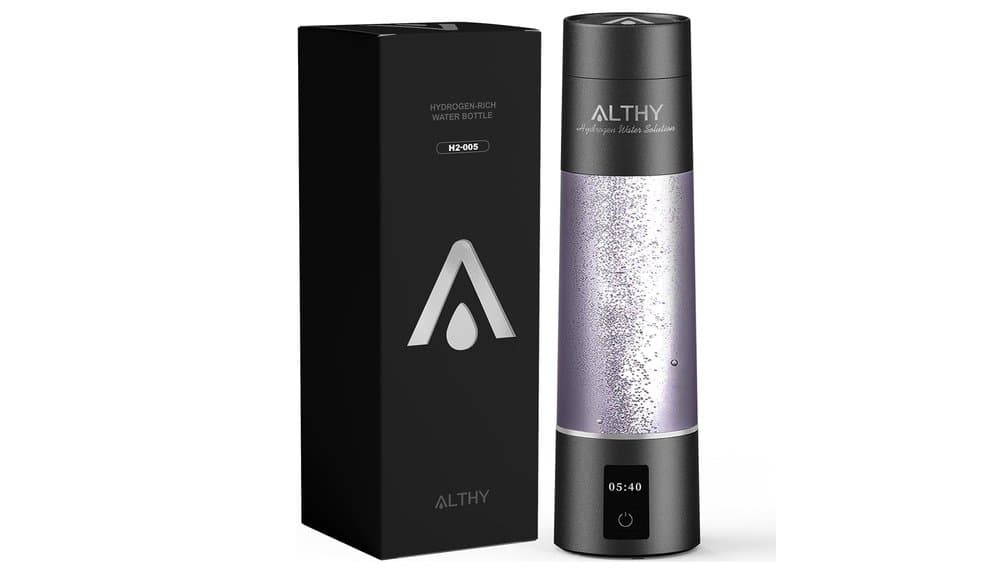
ALTHY Performance Hydrogen Water Bottle Review
Transform water into antioxidant-rich hydrogen water anywhere with the ALTHY portable bottle. A powerful, on-the-go wellness innovation.
Guides you might like
Alkaline Water Ionizer Buying Guide
Discover how alkaline water ionizers work and learn key tips to choose the right one for your home and health. Essential buying guide.
Buying Guide: Best Hydrogen Water Generator
Guide to hydrogen water generators: cutting through the hype to help you make an informed purchase decision for your health and budget.
Choosing Your Home Water Filter
Unlock clean, tasty water at home. Find the right water filter to tackle chlorine, pollutants, and limescale for better health and peace of mind.