VEVOR UV Sterilizer 12L Cabinet Review
Introduction
In the world of water purification, UV-C technology is a recognized pillar for its ability to neutralize microorganisms. However, its application extends far beyond treating liquid water. Today, we analyze the VEVOR UV Sterilizer 12L UV Disinfection Cabinet, a device that transposes this principle into a cabinet to disinfect solid objects. On a site dedicated to water quality, this exercise is valuable: it helps us understand the limits and the power of a technology, ultraviolet, which is also found in the form of lamps in some water purifiers. This product, presented as professional but sold for domestic use, deserves a frank analysis from the perspective of real-world effectiveness, ease of use, and its place in an overall health strategy.
Strong Points
Robust Construction and Large Capacity
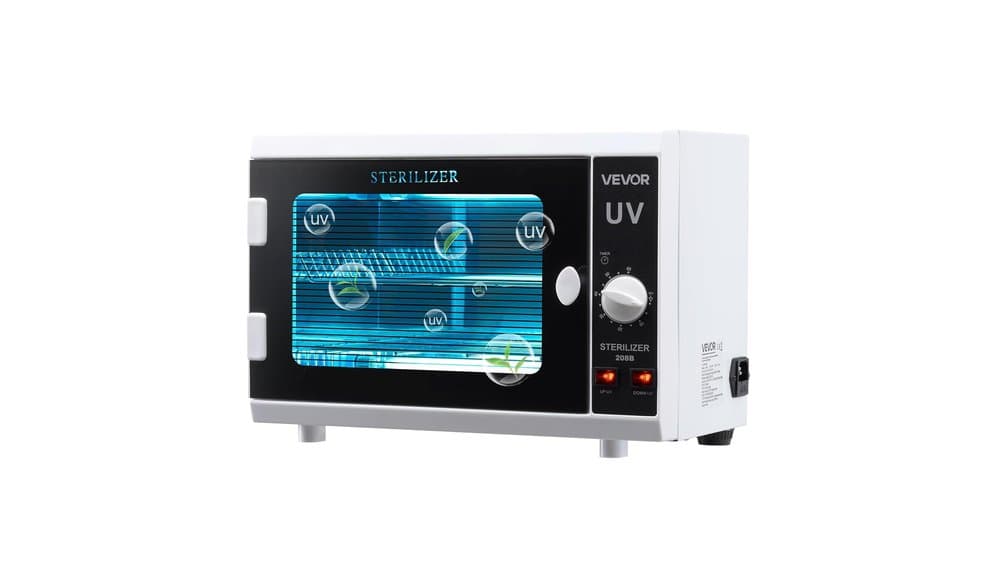
The first striking advantage is the solid construction. According to specifications and user feedback, the cabinet is made of double-layer carbon steel and equipped with a tempered glass door. This gives it appreciated durability for intensive use, such as in a salon, or repeated family use. The 12-liter capacity, organized with two removable trays, is a major advantage. It allows for the simultaneous treatment of many small objects (manicure tools, toothbrushes, baby utensils) or larger items like a pair of shoes or a diving mask, which small tabletop UV sterilizers cannot accommodate.
Simplicity of Use and Safety
Operation is described as extremely simple. A mechanical adjustable timer allows you to choose the sterilization duration, typically between 5 and 60 minutes. The door features an automatic closing mechanism and the tempered glass blocks UV rays, essential safety features for domestic use in the presence of children. Installation boils down to plugging the device into a power outlet: no plumber, no plumbing connection is required. Its footprint is that of a small microwave oven, easy to integrate on a countertop.
Weak Points
The Fundamental Limit of UV Technology on Surfaces
The main limitation comes not from the product itself, but from the physical principle of UV disinfection. Unlike a water filter that treats a continuous flow, this device only acts on surfaces directly exposed to the light. Shadows are the number one enemy. An object placed flat, or tools piled on top of each other, will have part of their surface untreated. The VEVOR 12L does not compensate for this weakness with an automatic rotation system or sophisticated reflective mirrors, an absence often noted in comparisons. The user must therefore be rigorous in positioning objects.
"Sterilization" vs. "Cleaning": A Misconception to Clear Up
A significant risk is the confusion between disinfection and cleaning. UV-C lamps do not remove dirt, organic residues, chemicals, or limescale deposits. They inactivate microorganisms (bacteria, viruses, mold) present on the surface. If a tool covered in residue is placed in the cabinet, the UV rays cannot reach the microbes underneath. A prior mechanical cleaning step (water and soap, disinfectant) is therefore absolutely essential for UV sterilization to be effective. This product is a final security step, not a car wash.
Detailed Analysis
Effectiveness Against Contaminants: What UV Does and Does Not Do
It is crucial to reposition this device within our "water and health" analysis framework. The VEVOR UV Sterilizer 12L is NOT a water purifier. It does not treat a flow of water. Consequently, it has no impact on the chemical water contaminants we typically look for:
- Chlorine, Heavy metals (lead, mercury), Nitrates, PFAS, Limescale, Microplastics: No action. UV technology does not have the capacity to remove or chemically modify these elements.
- Bacteria, Viruses, Mold, Yeast: This is where its area of excellence lies. The UV-C lamp at 185 nm (or more commonly 254 nm, the standard germicidal wavelength) emits radiation that damages the DNA/RNA of these pathogens, rendering them incapable of reproducing. Its effectiveness is real on exposed surfaces.
Comparing technologies clarifies its place:
- Reverse Osmosis: Eliminates a very wide spectrum (viruses, bacteria, metals, nitrates, PFAS). It's a complete water treatment.
- Activated Carbon: Excellent for chlorine, tastes, odors, certain chemicals and pesticides.
- UV (in water): Specialized in inactivating microorganisms, without altering the water's taste.
- Ion Exchange: Specialized in softening (limescale) or removing nitrates.
- Electrolysis: Generates disinfectants (chlorine) to treat water.
The VEVOR cabinet is therefore the "solid surface" equivalent of a water treatment UV lamp: a specialist in microbiological disinfection, to be used in a logical chain that includes cleaning.
Cost and Long-Term Maintenance
Unlike a filtration system, the consumable costs are very low and predictable. The only element to replace is the UV-C lamp. Its lifespan is typically 8000 to 9000 hours of use. With a daily 30-minute cycle, it can last for several years. The annual cost is therefore negligible, an undeniable strong point compared to cartridge systems or reverse osmosis membranes which require regular and costly replacements. There is no flow rate (L/h) or rejection rate to consider, as it is not a water filtration system.
Value for Money and Family Use
The value for money is often cited as a strong point. For a moderate initial investment, you acquire a robust, high-capacity device. For daily family use, it can find its place to disinfect objects such as toothbrushes, mobile phones, glasses, non-porous plastic baby toys, or bathroom accessories. However, its usefulness will depend on the level of hygiene requirements. It is not an indispensable appliance, but rather a hygiene supplement for households concerned about reducing the risk of cross-contamination on frequently handled objects.
Technical Specifications
| Feature | Detail |
|---|---|
| Product Name | VEVOR UV Sterilizer 12L UV Disinfection Cabinet |
| Technology | UV-C Lamp (185 nm / 254 nm) |
| Capacity | 12 Liters |
| Interior Design | 2 compartments / removable trays |
| Control | Mechanical adjustable timer (typically 5-60 min) |
| Safety | Tempered glass door, automatic closure |
| Construction | Double-layer carbon steel |
| Consumables | UV-C lamp (lifespan ~8000-9000h) |
| Installation | Simple electrical plug-in - No plumbing |
| Primary Use | Disinfection of solid object surfaces (tools, small everyday objects) |
What Users and Testers Say
A synthesis of customer feedback and available online analyses paints a clear consensus.
Recurring Positive Points: The community praises above all the robustness and finish of the device for its price. The large capacity is the number one purchase argument, allowing for varied uses. Users appreciate the ease of use ("you plug it in, set the timer, and off it goes") and the sense of security provided by the thick glass door and closing mechanism. Many highlight its versatility, moving from sterilizing salon tools to domestic objects (baby bottles, electronic sponges, keys).
Points of Caution and Criticisms: The most frequently reported flaw is directly linked to the absence of a system to homogenize exposure. "You really have to arrange the objects well, otherwise the sides in the shade are not treated" is a typical comment. Some more demanding users regret the very basic interface (a simple timer knob) compared to models with digital screens and programs. Finally, several testers warn against the illusion of "magic sterilization" and stress the absolute necessity of a prior cleaning of objects, a step that many seem to neglect, thereby reducing the actual effectiveness of the device.
Conclusion
The VEVOR UV Sterilizer 12L UV Disinfection Cabinet is a specialized tool that fulfills a precise function with a simple and robust approach. Its analysis reminds us of a golden rule in purification: one technology, one goal. Here, the goal is the microbiological disinfection of solid surfaces, and UV-C technology does it well, provided its physical (shadow-free exposure) and logistical (prior cleaning) constraints are respected.
It should not be seen as a miracle solution or a piece of water purification equipment, but rather as a practical hygiene supplement for a household or small salon. Its excellent value for money, low maintenance, and large capacity make it a relevant choice for those who understand its mode of action and are willing to manually manage object positioning. For a family looking to secure the hygiene of small everyday objects after cleaning them, it represents a sensible investment. For anyone seeking to eliminate chemical contaminants or treat water, however, it is completely off-topic, and one must turn to dedicated technologies like reverse osmosis or activated carbon.
100% free and independent — All our articles are written independently, without any sponsorship. We may earn a commission on purchases made through our links, at no extra cost to you.
Articles you might like
Apera TDS20 TDS Pocket Tester Review
Learn how to verify your water filter's effectiveness against contaminants like chlorine, heavy metals & PFAS over time. Ensure your system delivers.
ORIA Anti-Limescale & Impurity Filter Kit Review
Complete ORIA 12-month filter cartridge kit review. We analyze its actual performance against limescale & impurities for water quality & health.
FEELNEEDY FN-W14 7L Stainless Steel Pet Fountain Review
FEELNEEDY FN-W14 pet fountain analysis: assessing if its 7L capacity and design truly deliver cleaner, healthier water for your pets.
Guides you might like
Alkaline Water Ionizer Buying Guide
Discover how alkaline water ionizers work and learn key tips to choose the right one for your home and health. Essential buying guide.
Buying Guide: Best Hydrogen Water Generator
Guide to hydrogen water generators: cutting through the hype to help you make an informed purchase decision for your health and budget.
Choosing Your Home Water Filter
Unlock clean, tasty water at home. Find the right water filter to tackle chlorine, pollutants, and limescale for better health and peace of mind.