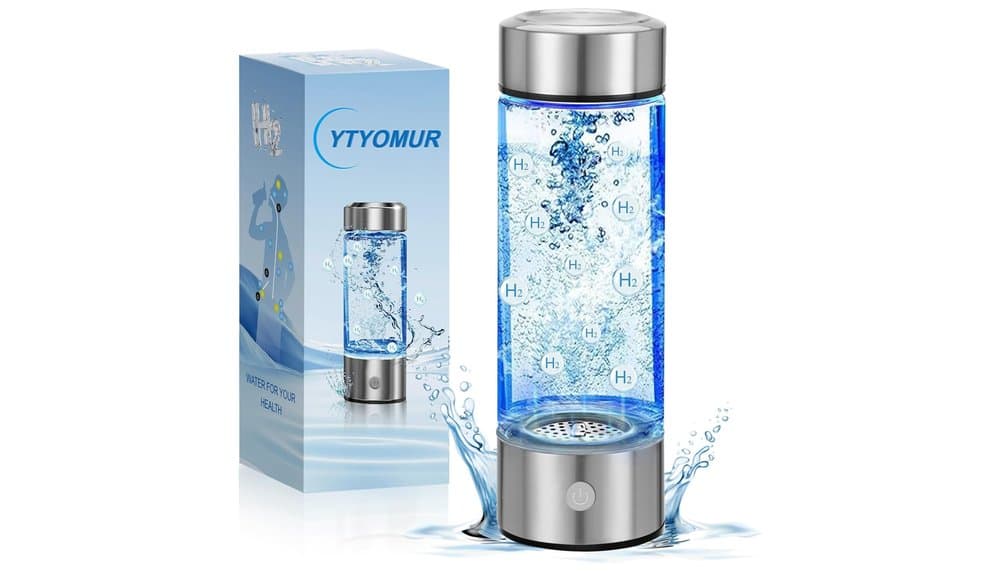
YTYOMUR Hydrogen-Rich Cup Water Bottle Review
Introduction
In the world of portable solutions to improve drinking water quality, hydrogen bottles are generating buzz. The product YTYOMUR Tazza Ricca di Idrogeno Hydrogen Water Bottle promises to transform any water into water enriched with molecular hydrogen, with advertised wellness benefits. But what is the reality behind the marketing promises? For a site dedicated to purification, it is crucial to dissect this object from the angle of the quality of water produced, the technology used, and its real utility in a health approach. Unlike a classic purifier, this bottle does not filter. Its role is to add a component to water that is already (ideally) healthy. Our analysis is based on the manufacturer's technical specifications, feedback from a large community of users, and observations shared by experts and testers on the web.
Strong Points
The YTYOMUR Tazza Ricca di Idrogeno presents several characteristics that, on paper, make it an attractive product for enthusiasts of portable health solutions.
- Targeted Technology: It uses SPE (Solid Polymer Electrolyte) and PEM (Proton Exchange Membrane) technologies. This is a crucial point. According to experts, a quality PEM membrane allows for effective separation of the hydrogen and oxygen generated during electrolysis, thus avoiding the production of undesirable by-products like ozone or chlorine gas, especially with tap water rich in minerals.
- Portability and Autonomy: Designed as a portable accessory, it is rechargeable via a USB-C cable, making it usable while traveling, at the office, or at the gym without depending on a power outlet. Its battery life is advertised for several hydrogenation cycles.
- Quality Materials: The bottle is made of borosilicate glass, an inert material that does not alter the taste of the water and avoids the migration of undesirable compounds, unlike some plastics. The electrodes are platinum-plated titanium, supposed to offer good durability and efficient electrolysis.
- Ease of Use: The process is presented as very simple: fill, press a button, and wait about 3 minutes to get your hydrogenated water. No complex installation is required.
Weak Points and Intrinsic Limits
It is imperative to understand what this product is not and what its functional limits are before considering it for daily use.
- Not a Water Purifier: This is the most important limitation. The YTYOMUR Tazza Ricca di Idrogeno Hydrogen Water Bottle does not remove any contaminants. It does not act on chlorine, heavy metals, limescale, nitrates, PFAS, or microplastics. It adds hydrogen to the water you put in it. If your starting water is of poor quality, the hydrogenated water will be equally poor, or even worse if the electrolysis generates by-products.
- Potential Hygiene Issues: The web context and customer reviews point to a recurring risk for this type of device: the development of mold and bacteria in internal components, particularly around the membrane and electrodes. Some testers mention plastic parts that are difficult to access for cleaning, nicknamed "stink stars," which can become a breeding ground for microbes.
- Unverifiable Hydrogen Concentration: The manufacturer advertises "up to 1300 PPB" (i.e., 1.3 PPM), but this measurement is rarely verified by the end user. Experts often recommend aiming for concentrations above 2.5-5 PPM for a noticeable effect. Without independent certification (like those from the IHSA - International Hydrogen Standards Association), this claim remains a manufacturer's statement.
- Dependence on Starting Water Quality: The manufacturer even recommends letting tap water sit to allow chlorine to evaporate before use. For an optimal result and to protect the electrodes, it is strongly advised to use pre-filtered or low-mineral water.
Detailed Analysis: Technology, Efficacy, and Value for Money
Technology Under the Microscope: Electrolysis with PEM Membrane
The promise relies on water electrolysis. An electric current (supplied by the built-in battery) decomposes water molecules (H₂O) into hydrogen (H₂) and oxygen (O₂) at the titanium-platinum electrodes. The PEM/SPE membrane plays a key role: it acts as a molecular filter, allowing only hydrogen ions (protons) to pass through to recombine into molecular hydrogen (H₂) on the cathode side, while the oxygen is vented or separated. It is this technology that distinguishes serious generators from gadgets. According to feedback from the technical community, its proper functioning is often verified by a discreet vent allowing the evacuation of the oxygen produced.
In comparison with other water treatment technologies we usually evaluate:
- Activated Carbon / Reverse Osmosis: They remove contaminants. The YTYOMUR bottle has none of these functions.
- UV Lamp: It disinfects water by eliminating bacteria and viruses. The YTYOMUR bottle has no proven disinfection function.
- Ion Exchange: It softens water by removing calcium and magnesium ions. This is not the goal of this product.
Its real efficacy is therefore limited to a single parameter: enrichment with dissolved molecular hydrogen.
Ease of Use and Cost of Ownership
Installation is non-existent: it is a fully autonomous device. Its size is that of a classic water bottle. However, ease of maintenance is a major point of vigilance. According to feedback, regular and meticulous cleaning is essential to avoid odors and microbiological contamination. The annual cost of consumables is theoretically zero, as there are no filters or cartridges to replace. However, the lifespan of the electrodes and the PEM membrane is not clearly defined. Degradation of these components, accelerated by poor quality water (very hard or rich in minerals), would reduce the efficiency of hydrogen production until it becomes nil, turning the bottle into a simple container.
What Flow Rate? What Waste?
The notions of flow rate in liters per hour and rejection rate are specific to under-sink filtration systems, like reverse osmosis. They do not apply to this bottle. It treats a fixed volume of about 430 ml per cycle, in about 3 minutes. There is no wastewater, only oxygen evacuated as a gas.
Summarized Technical Specifications
| Characteristic | Detail for the YTYOMUR Tazza Ricca di Idrogeno |
|---|---|
| Main Technology | Electrolysis with SPE/PEM membrane |
| Contaminants Removed | None. It is not a filter. |
| Added Health Function | Production of dissolved molecular hydrogen |
| Advertised Concentration | Up to 1300 PPB (1.3 PPM) |
| Treatment Time | ~3 minutes for ~430 ml |
| Capacity | 450 ml |
| Reservoir Material | Borosilicate glass |
| Electrodes | Platinum-plated titanium |
| Power Supply | Lithium-polymer battery, USB rechargeable |
| Maintenance | Frequent manual cleaning. No regular consumables to change. |
| Installation | None, portable use. |
What Users Say: Synthesis of Customer Reviews and Expert Feedback
Available customer reviews and technical analyses paint a nuanced picture of the product.
The recurring positive points are:
- A perception of better taste of the water, described as "softer," "lighter," or "purer" by several users.
- Satisfaction with the build and materials (glass, stainless steel), often perceived as superior quality to plastic.
- Ease of use widely praised: the single button and USB charging are appreciated.
- Some users report subjective effects on well-being, such as a feeling of having more energy, less fatigue, or improved kidney function (according to one review). However, these feedbacks are anecdotal and not scientifically verified.
The negative points and warnings are equally instructive:
- Absence of Perceptible Effects: A significant number of users note having felt no change in their health or well-being after several weeks of regular use. "We don't feel any effect," specifies one of them.
- Functioning Problems: Malfunctions appear, such as an absence of bubble production (a visual sign of electrolysis), calling into question the product's efficacy. One customer even reports that several purchased units had this defect.
- Incompatibility with Tap Water: Several reviews confirm the problem raised by experts. Tap water, especially if rich in chlorine or minerals, can make the water cloudy or opaque after electrolysis and risks damaging the device in the long run. This forces the use of pre-filtered water, adding a step and a cost.
- Hygiene Problems: Although not explicitly described in the provided reviews, the web context heavily emphasizes this risk for the category in general. The necessity of extremely rigorous and regular cleaning is stressed to avoid bad odors and health risks.
Conclusion
The YTYOMUR Tazza Ricca di Idrogeno Hydrogen Water Bottle is a technically interesting object that materializes the concept of water hydrogenation in a portable and simple format. Its use of SPE/PEM technologies is a point in its favor on paper, aiming to produce pure hydrogen.
However, our analysis leads us to a clear conclusion: this product can in no way be considered a solution for water filtration or purification. It is imperative to understand that it functions with already clean water. Its use with unfiltered tap water can be counterproductive, even harmful to the device's longevity. Its role is solely to add dissolved hydrogen, a molecule studied for its antioxidant properties, but whose concrete benefits at the produced concentration remain a subject of scientific debate and whose subjective effects vary greatly from one individual to another.
Its value for money for daily family use is therefore questionable. It requires an initial investment, rigorous maintenance discipline, and already assumes access to a quality water source (under-sink filter, filter pitcher, low-mineral bottled water). For a household whose priority is first to improve the chemical and microbiological quality of its water, the investment should first be directed towards a true filtration system (activated carbon, reverse osmosis) adapted to local contaminants.
This bottle finds its place more as a complementary and portable accessory for individuals already convinced of the benefits of hydrogenated water, who have access to very high-quality starting water, and are ready to provide meticulous maintenance. For everyone else, it mainly represents an experience whose tangible benefits remain, according to community feedback, largely uncertain.
100% free and independent — All our articles are written independently, without any sponsorship. We may earn a commission on purchases made through our links, at no extra cost to you.
Articles you might like
Alkaline Water Ionizer 11-Plate Electrode Test
Analyzes the 11-plate alkaline water ionizer: Does it filter water effectively, alter its properties, and deliver promised health benefits for a family?
TOODO Fleck 5800 SXT Monobloc Water Softener Review
Volumetric TOODO Fleck 5800 SXT water softener eliminates limescale efficiently for families. A review of features & performance.
Ecoviva E6 Reverse Osmosis Water Filter Review
Compact, tankless Ecoviva E6 reverse osmosis system analyzed. We test its real-world purification performance, health benefits, and home integration.
Guides you might like
Alkaline Water Ionizer Buying Guide
Discover how alkaline water ionizers work and learn key tips to choose the right one for your home and health. Essential buying guide.
Buying Guide: Best Hydrogen Water Generator
Guide to hydrogen water generators: cutting through the hype to help you make an informed purchase decision for your health and budget.
Choosing Your Home Water Filter
Unlock clean, tasty water at home. Find the right water filter to tackle chlorine, pollutants, and limescale for better health and peace of mind.