AAwipes K03-100 17-in-1 Water Test Strips Review
Introduction
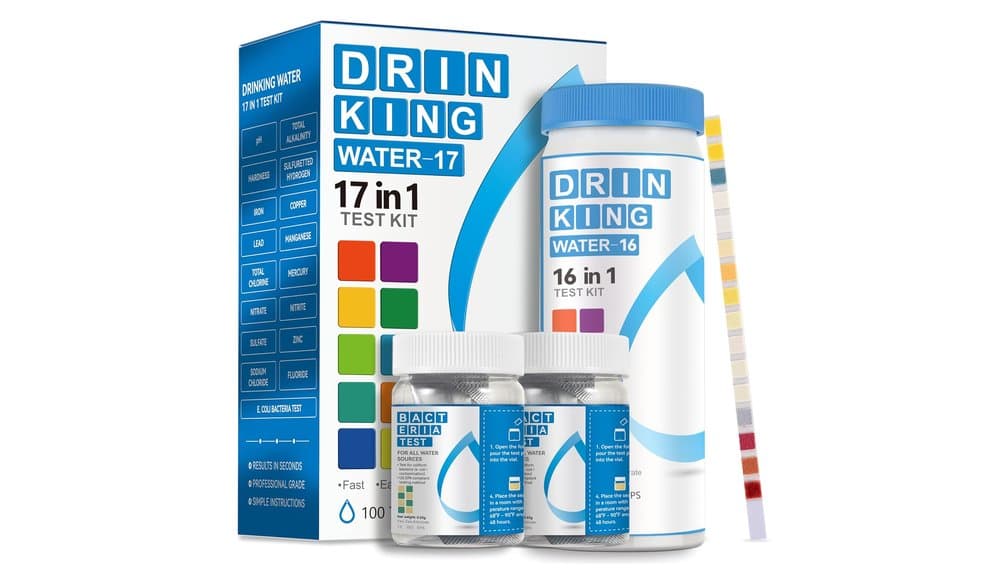
In the world of home water filtration, knowing what comes out of our tap is the essential first step before choosing a purification system. The AAwipes K03-100 17-in-1 Drinking Water Test Strips with Bacterial Test Kit presents itself as a miniature analysis lab, promising a comprehensive overview in just a few seconds. On a site dedicated to water quality, our analysis is not about a filter, but about the tool that allows us to assess the need for one and its effectiveness. We will dissect this product from our perspective: is it a reliable ally for diagnosing the contaminants targeted by our systems and checking their performance?
Key Strengths
Analysis of the specifications and user feedback highlights several convincing strengths for users concerned about their water quality.
- Impressive Analytical Versatility: The kit tests 17 parameters, covering common concerns (pH, hardness, chlorine) and more critical contaminants like lead, iron, nitrites, and nitrates. The inclusion of 2 separate bacterial tests (for coliforms/E. coli) is a significant bonus compared to most test strips on the market.
- Simplicity and Speed of Use: The "dip, shake, wait 30 seconds, compare" procedure is universally praised. This makes it an accessible tool requiring no technical skills, perfect for regular checks of tap water, well water, or water after filtration.
- Advantageous Quantity/Durability Ratio: The box of 100 test strips offers long-term monitoring capacity. On paper, this allows for weekly tests for nearly two years, a strong argument for a family committed to tracking their water quality.
- Usefulness for Validating a Filtration System: For us, this is a key point. This kit allows for a "before/after" test of a filter. One can thus visually verify the reduction of chlorine (taste, odor), the adjustment of pH, or the decrease of certain metals like iron, providing tangible proof of the effectiveness of activated carbon cartridges or water softeners.
Weak Points
However, this consumer-grade approach has inherent limitations that must be understood to use the product for its true worth.
- Semi-Quantitative and Indicative Precision: This is the main limitation. Testers and experts agree: these strips are a screening tool, not a laboratory diagnosis. The colorimetric reading is subject to interpretation (lighting, eyesight) and does not give an exact concentration. For a serious contaminant like lead, a "positive" result absolutely must be confirmed by a certified laboratory test. They do not detect complex contaminants like PFAS or microplastics.
- Complexity of Reading 17 Parameters: The comprehensiveness can become a flaw. Quickly comparing a strip to a color chart with 17 different pads requires attention. According to feedback, some users find the reading not very intuitive or difficult to interpret to know if the water is "drinkable".
- Logistical and Support Issues: Several customer reviews report two recurring pitfalls. First, problems with expiration dates, with batches expiring just a few months after purchase, drastically reducing the promise of "2 years of protection". Second, the absence of French translation for the instructions and chart, noted by users in France, makes the kit less accessible to part of the clientele.
- Limited Number of Bacterial Tests: Although their inclusion is a plus, only 2 tests are provided. For regular monitoring of a well, for example, this is insufficient, and these tests must be purchased separately.
Detailed Analysis
What This Kit Can (and Cannot) Tell You About Your Filtration Technologies
Let's delve deeper into the practical utility of this product in the context of home water purification.
- For Chlorine: This is one of its strong points. The strips detect total and free chlorine. They are therefore perfect for checking the effectiveness of an activated carbon cartridge (in a pitcher, under-sink, or whole-house). A good carbon filter should significantly reduce the color on the strip.
- For Heavy Metals (Lead, Iron, Copper): It gives an indication of presence. A color change signals a potential problem. However, it does not specify whether the concentration is just above the detection threshold or at a dangerously high level. For lead, following a positive result, a laboratory analysis is imperative. It does not replace a specific, quantitative test.
- For Limescale (Hardness): The hardness measurement (calcium and magnesium) is reliable for indicative use. It allows one to determine if a salt-based water softener is necessary or if it is working correctly. It is a useful and sufficiently precise measurement for this domestic need.
- For Nitrates/Nitrites: Detection is present. This is crucial for well water users or those in agricultural areas. A positive result indicates contamination and justifies installing an appropriate system (reverse osmosis, specific ion exchange).
- What it Does NOT See: It is essential to remember that this kit is ineffective against PFAS (forever chemicals), complex pesticides, pharmaceutical residues, or microplastics. Its chart does not mention them. For these contaminants, only advanced filtration (reverse osmosis with specific pre-treatment, certain high-performance activated carbons) coupled with specialized analyses is relevant.
Place in the Water Quality Ecosystem
The AAwipes K03-100 does not filter, but it informs. Its role is preventive and for monitoring. It answers the question: "Is there a problem with my water?" and "Is my filter still doing its job?". It is a logical complement to any filtration system. Before investing in a reverse osmosis system (with annual costs for membranes and filters to consider) or a UV system (effective against bacteria only), this test provides an initial orientation on which parameters to target.
Technical Specifications
| Parameter | Detail |
|---|---|
| Product Name | AAwipes K03-100 17-in-1 Drinking Water Test Strips with Bacterial Test Kit |
| Parameters Tested | pH, Total Hardness (TH), Alkalinity, Free Chlorine, Total Chlorine, Fluoride, Nitrite, Nitrate, Lead, Iron, Copper, Sulfate, Manganese, Carbonate, Sodium, + 2 separate bacterial tests (for coliforms / E. coli) |
| Result Time | ~30 seconds for strips; 48h for bacterial tests |
| Quantity | 100 test strips + 2 bacterial tests |
| Shelf Life | Advertised: 24 months (to be verified upon receipt) |
| Recommended Uses | Tap water, well water, stored water, spring water, monitoring filtration systems |
| Ease of Installation | None. Ready for immediate use. |
| Accuracy | Semi-quantitative, based on colorimetric comparison. Screening level. |
What Users and Testers Say
The synthesis of 305 global reviews (average rating 4.2/5) and online expert analyses paints a nuanced consensus.
Recurring Positive Trends:
- Ease and Speed: Phrases like "very simple," "result in 30 seconds," "easy to use" come up constantly. Users appreciate the frictionless procedure.
- General Satisfaction with Detection: Many note that the strips react well and allow them to distinguish different water qualities (tap, filtered, distilled). Some who cross-referenced results with electronic testers find the measurements consistent.
- Ideal for Regular Filter Checks: Several reviews, like one from a user checking her filtered water, emphasize that it is a perfect tool for monitoring the effectiveness of a home filtration system without having to go anywhere.
Frequent Criticisms and Warnings:
- Expiration Date Problems: This is the most reported issue. Customers receive batches expiring only 5 to 6 months after purchase, contradicting the marketing promise. This casts doubt on the reliability of storage and the supply chain.
- Difficult Reading and Interpretation: Some find the color chart too complex or unclear for determining if the water is safe. One review summarizes: "Hard to understand if the water is drinkable."
- Lack of Translation: For the French-speaking market, the complete absence of instructions in French is a major barrier to correct use, noted as a deal-breaker by some.
- Indicative Nature of Results: Expert testers remind us that the accuracy is "rough" (approximate) and suitable for a basic check. The community understands that it is not a substitute for professional analysis, especially for lead.
Conclusion
The AAwipes K03-100 17-in-1 Drinking Water Test Strips with Bacterial Test Kit is a product that fits perfectly into the toolkit of any household concerned about its water. Its analytical versatility and ease of use make it an excellent tool for preliminary and regular monitoring.
Our analysis concludes that its primary value lies in the routine control of your existing filtration systems' performance – to verify the reduction of chlorine by your activated carbon or the effectiveness of your water softener – and in screening for general imbalances (pH, hardness, presence of nitrates). The inclusion of bacterial tests, although limited in number, adds an appreciable layer of security for well water.
However, it is imperative to consider its limits. It is not a laboratory measurement instrument. For serious contaminants like lead, or for searching for emerging pollutants (PFAS), it is insufficient. The reported problems with expiration dates and the lack of translation are real weaknesses that can ruin the experience.
In summary: buy it as a thermometer for the general quality of your water and the state of your filter, not as a complete medical scanner. For the price, the quantity offered, and the range of parameters, it represents good value for money for family monitoring use, provided you receive a product with a valid shelf life and can understand the instructions.
100% free and independent — All our articles are written independently, without any sponsorship. We may earn a commission on purchases made through our links, at no extra cost to you.
Articles you might like
Alkaline Water Ionizer 11-Plate Electrode Test
Analyzes the 11-plate alkaline water ionizer: Does it filter water effectively, alter its properties, and deliver promised health benefits for a family?
TOODO Fleck 5800 SXT Monobloc Water Softener Review
Volumetric TOODO Fleck 5800 SXT water softener eliminates limescale efficiently for families. A review of features & performance.
Ecoviva E6 Reverse Osmosis Water Filter Review
Compact, tankless Ecoviva E6 reverse osmosis system analyzed. We test its real-world purification performance, health benefits, and home integration.
Guides you might like
Alkaline Water Ionizer Buying Guide
Discover how alkaline water ionizers work and learn key tips to choose the right one for your home and health. Essential buying guide.
Buying Guide: Best Hydrogen Water Generator
Guide to hydrogen water generators: cutting through the hype to help you make an informed purchase decision for your health and budget.
Choosing Your Home Water Filter
Unlock clean, tasty water at home. Find the right water filter to tackle chlorine, pollutants, and limescale for better health and peace of mind.