Philips ADD6921DG RO Water Station Review
Introduction
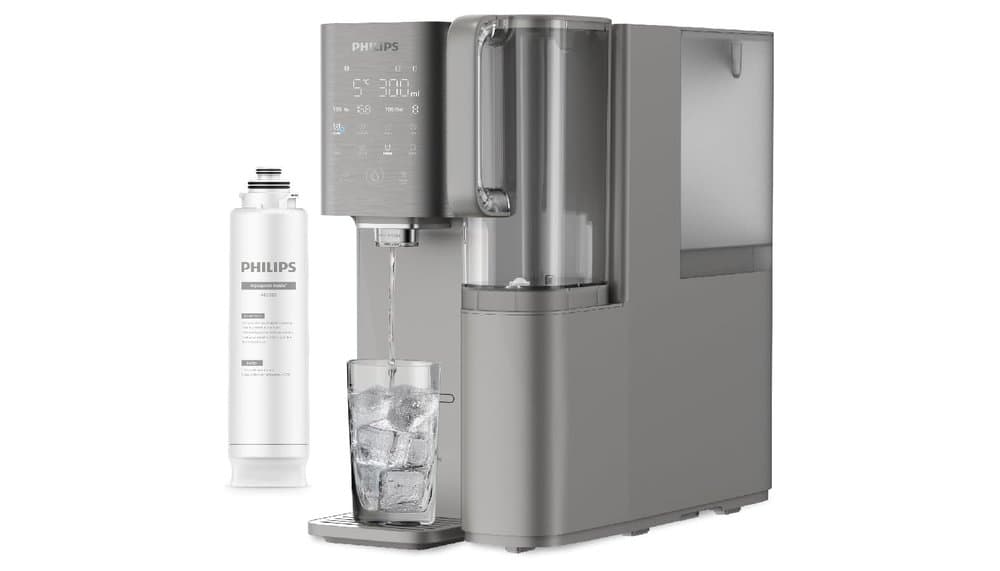
The world of home water filtration is vast, and reverse osmosis systems hold a place of excellence for their ability to produce water of high purity. But what happens when this technology is integrated into an all-in-one station, capable of heating, cooling, and dispensing water on demand? This is what the Philips Water ADD6921DG Reverse Osmosis Water Station offers. This hybrid product aims to replace both the water filter pitcher, the kettle, the water cooler, and plastic bottles. We will dissect this promise from every angle: filtration performance for health, cost of use, ease of daily life, and what users actually get out of it. A product that sparks interest, but also practical questions that we will explore.
Strong Points
- High filtration performance: Reverse osmosis, combined with pre- and post-filters, removes a very wide range of contaminants, from the most common to the most concerning like PFAS.
- All-in-one functionality: The ability to instantly provide cold water at 5°C or hot water at 100°C directly from the tap is a major gain in time and comfort.
- User interface and monitoring: The screen displaying the TDS before/after and the filter life indicator offer reassuring transparency about water quality.
- Practical design: The system with two 1.8-liter carafes allows for serving at the table without moving the station, an asset for family meals.
Weak Points
- Size and autonomy: With its 37.4 x 23 x 42.7 cm dimensions, the appliance requires significant countertop space. The 6-liter tank may require frequent refills for large families.
- Refill complexity: According to user feedback, refilling the tank directly from the tap without removing it is considered impractical, even impossible according to some.
- Annual consumable cost: The use of a reverse osmosis membrane and several cartridges (pre-filter, mineralizing post-filter) generates a recurring cost that must be anticipated.
- Reported logistical issues: Several customer reviews mention receiving clearly already used or poorly packaged appliances, raising questions about the distribution chain.
Detailed Analysis
Water Quality and Health: What Does This Station Really Remove?
This is the core of our analysis. The Philips Water ADD6921DG relies on a combination of technologies: sediment filtration (for large particles), activated carbon filtration (for organic compounds, chlorine and its by-products), reverse osmosis (RO) itself, and UV-C sterilization at the end of the cycle.
On paper, the specs announce the removal of up to 110 substances. This is a marketing figure covering a wide range. More concretely, according to technical data, the system is designed to target:
- Heavy metals (lead, mercury): RO is very effective against these ionic contaminants.
- Organic compounds and PFAS: The activated carbon filters and the RO membrane (with a stated porosity of 0.0001 micron) capture these persistent pollutants. The datasheet indicates a PFAS rejection rate of over 99%, which is a serious level.
- Nitrates and pesticides: RO is one of the few domestic technologies effective at significantly reducing these solutes.
- Limescale (hardness): The RO process removes calcium and magnesium ions, producing "soft" water. However, this is where the included remineralization filter comes in. It reintroduces certain minerals (like magnesium and calcium in a controlled form) to improve taste (completely demineralized water is often considered "flat") and potentially the water's balance. It does not restore the original hardness, but avoids aggressive water.
- Microplastics and bacteria: The fineness of the membrane blocks microscopic particles, and the UV-C step deactivates 99.9% of bacteria and viruses that could develop in the internal tank, a real plus for sanitary safety.
Technology comparison: Compared to a simple carbon filter (like a Brita pitcher), RO is much more comprehensive. It treats families of pollutants (nitrates, fluoride, perchlorate) that carbon alone cannot eliminate. Compared to an ion-exchange water softener, it does not just exchange calcium/magnesium ions for sodium, it physically removes them from the water. It is therefore a purification solution rather than simple treatment.
Practical Performance: Flow Rate, Wastewater, and Daily Use
The flow rate of a reverse osmosis system is always lower than that of a standard tap. Here, it is not explicitly given in liters per hour, but the logic of the station with a 6-liter buffer tank compensates for it. Water is purified upstream and stored, allowing for a high instantaneous flow rate at the tap, for both hot and cold. This is a decisive advantage over classic under-sink systems where you often have to wait for the small pressurized tank to refill.
The wastewater ratio is the sensitive point of traditional RO: to produce 1 liter of pure water, it can reject 3 to 5 liters to the drain. Feedback on this specific model is not very talkative about this ratio, but the principle remains valid. It is an environmental and economic cost (increase in water bill) to consider. Some high-end models integrate repressurization pumps to reduce this ratio; nothing indicates this is the case here.
For installation, this is a strong point: it is a countertop system, without permanent plumbing. It connects via a quick-connect adapter to the kitchen tap for the time it takes to fill the tank, then is disconnected. This makes it very accessible but imposes the manual chore of refilling, a negative point highlighted by several users.
Long-Term Cost and Maintenance
The acquisition cost is a separate subject, but the cost of ownership is crucial. The main filter (likely integrating the pre-filters, RO membrane, and post-filter) has an announced lifespan of one year. Its reference number is ADD583/10. Based on observed prices for consumables of this type, one should expect a significant annual cost, often between €100 and €200. This is a recurring budget to integrate. The user community also notes the need for weekly cleaning of the 6-liter tank with vinegar or citric acid to prevent deposits and biofilms, which adds a maintenance task.
What Users Say: Between Enthusiasm and Practical Frustrations
A synthesis of customer reviews (notably on marketplaces) paints a very instructive chiaroscuro landscape.
Recurring positive points:
- Water quality and taste: This is the number one reason for satisfaction. Users describe "crystal clear" water, "better than most bottled waters", with a "pure" taste that encourages drinking more.
- Comfort of temperature functions: The possibility of having very cold water or water at the exact temperature for tea/instant tea in a few seconds is highly praised. "I can't do without it anymore" is a recurring phrase.
- Ease of daily use (once installed): The automatic carafe system and preset volumes (150/200/300 ml) are considered very practical.
Negative points and alerts:
- Delivery and product condition issues: Several reviews report receiving an appliance clearly already used, damp, with water marks and an already unwrapped power cord. This casts a shadow on the quality control of the logistics chain for this product.
- Refilling considered impractical: The inability to easily refill the 6-liter tank without removing and carrying it (which can be heavy and cumbersome under a tap) is frequent criticism. Some mention that the station does not recognize the water level if poured directly in.
- Limited autonomy: For a family of 4 or more, the 6-liter tank may require several refills per day, which diminishes the "practical" aspect.
- After-sales support and spare parts: A user in Sweden reports difficulties obtaining technical support or spare parts, as the product is not listed in their local catalog. Others mention difficulty reaching customer service.
- Assembly details: The presence of very tenacious adhesive protective plastic films, difficult to remove without leaving glue residue, is noted as a frustrating detail for a product in this segment.
Technical Specs
| Characteristic | Detail |
|---|---|
| Filtration Technology | Reverse Osmosis (RO) + Sediment Filter + Activated Carbon + UV-C Sterilization + Remineralization Filter |
| Targeted Contaminants | Up to 110 substances including PFAS (>99%), heavy metals, nitrates, microplastics (0.0001 micron), chlorine, bacteria/viruses (UV-C) |
| Tank Capacity | 6 liters |
| Included Carafes | 2 x 1.8 liter (automatic filling) |
| Temperature Functions | 6 presets: Cold (5°C), Room Temp, Hot (45°C, 55°C, 85°C, 100°C) |
| Flow Rate | Instantaneous (pretreated stored water) |
| Indicators | Screen with TDS measurement before/after, filter life indicator |
| Filter Lifespan | Approximately 1 year (model: ADD583/10) |
| Installation | Countertop. Temporary connection to tap for refilling. |
| Dimensions (W x D x H) | 37.4 x 23 x 42.7 cm |
| Power Supply | Electrical (for heating, cooling, screen, and UV-C) |
Conclusion
The Philips Water ADD6921DG Reverse Osmosis Water Station is an ambitious product that attempts to synthesize the excellence of reverse osmosis purification with the comfort of a multi-function water cooler. On the health and water purity front, the specifications are solid and correspond to what is expected from a good RO system coupled with UV-C. Its ability to remove emerging contaminants like PFAS is a strong argument.
However, its adoption in a household will largely depend on tolerance for the practical compromises it imposes. On one hand, it offers total temperature freedom and high-quality water. On the other, it is bulky, requires vigilance regarding tank refilling, and represents a non-negligible annual consumable cost. The concerning feedback about deliveries of already used appliances should also encourage great caution regarding the choice of retailer.
In the end, this station is aimed at a family prioritizing above all water quality and the comfort of access to hot/cold water, with ample counter space and ready to assume the refill routine and regular maintenance. For those seeking primarily effective filtration without the "cooler" functions, a classic under-sink reverse osmosis system could be a simpler and less cumbersome option. The technological promise of the Philips ADD6921DG is real, but its perfect integration into daily life requires overcoming some operational constraints that early users have clearly identified.
100% free and independent — All our articles are written independently, without any sponsorship. We may earn a commission on purchases made through our links, at no extra cost to you.
Articles you might like
Alkaline Water Ionizer 11-Plate Electrode Test
Analyzes the 11-plate alkaline water ionizer: Does it filter water effectively, alter its properties, and deliver promised health benefits for a family?
TOODO Fleck 5800 SXT Monobloc Water Softener Review
Volumetric TOODO Fleck 5800 SXT water softener eliminates limescale efficiently for families. A review of features & performance.
Ecoviva E6 Reverse Osmosis Water Filter Review
Compact, tankless Ecoviva E6 reverse osmosis system analyzed. We test its real-world purification performance, health benefits, and home integration.
Guides you might like
Alkaline Water Ionizer Buying Guide
Discover how alkaline water ionizers work and learn key tips to choose the right one for your home and health. Essential buying guide.
Buying Guide: Best Hydrogen Water Generator
Guide to hydrogen water generators: cutting through the hype to help you make an informed purchase decision for your health and budget.
Choosing Your Home Water Filter
Unlock clean, tasty water at home. Find the right water filter to tackle chlorine, pollutants, and limescale for better health and peace of mind.