RO systems, PFAS and TFA: what actually filters
Verdict
This guide sets out, as of the dates cited below, what is known about TFA and PFAS in tap water and what a domestic reverse-osmosis system can, or cannot, be said to do. Official monitoring of TFA at the tap is due on 1 January 2027.
Method. We do not run custom water analyses. A reverse-osmosis unit is not a medical device; performance depends on the system and on upkeep.
Trifluoroacetic acid, or TFA, is an ultra-short-chain PFAS. It is not part of the "sum of 20 PFAS" parameter already monitored in tap water. Even so, the national Anses campaign found it in the great majority of samples, and French law provides for adding it to official monitoring from 1 January 2027. This page reviews what the texts and agencies say, and what a home reverse-osmosis system can reasonably be claimed to do. We have not measured TFA ourselves at the outlet of these units: no invented removal rate appears here.
For choosing a system and the basic vocabulary (membrane, tank, TDS, maintenance), start with our reverse-osmosis buying guide and, before that, choosing a home water filter.
What the law already requires, and what changes in 2027
Directive (EU) 2020/2184, transposed into French law, set a list of 20 PFAS to monitor. According to ARS Pays de la Loire, which restates that framework, the quality limit is 0.10 µg/L for the sum of those 20 substances in water at the tap, and 2 µg/L in raw water, before treatment.
Decree no. 2025-1287 of 22 December 2025, adopted to apply law no. 2025-188 of 27 February 2025, inserts article D. 1321-15-2 into the French public health code. It lists the molecules the analysis programme must look for. The first twenty match the PFAS already targeted by the directive. Item 21° adds 6:2 fluorotelomer sulfonic acid (6:2 FTSA). Item 22° adds trifluoroacetic acid (TFA). Article 2 of the decree is explicit: the text enters into force on 1 January 2026, except for those 21° and 22° items, which enter into force on 1 January 2027.
From that date, TFA must be sought in official monitoring. The decree does not, by itself, create a numerical quality limit for TFA. An analysis can therefore remain compliant on the sum of 20 PFAS while still reporting TFA: compliance is about the regulated parameter, not automatically about this molecule.
What Anses measured in tap water
On 3 December 2025 Anses published the results of its 2023-2025 national campaign on PFAS in water intended for human consumption. More than 600 raw-water samples and as many distributed-water samples were analysed, at points representing about 20 % of the water distributed in France. Of 35 PFAS sought, 20 were detected at least once in raw water and 19 in distributed water.
TFA was the most frequent ultra-short-chain PFAS followed in that campaign: it was found in 92 % of both raw-water and distributed-water samples. The median in distributed water is 780 ng/L, or 0.78 µg/L, with wide scatter from one sample to another. The study also reports, for the first time in a significant way in France, TFMSA (trifluoromethanesulfonic acid), in 13 % of samples, with a median of 28.5 ng/L in distributed water.
These figures describe frequent presence, at median concentrations well below the indicative health value the authorities discuss for TFA. They do not say that a domestic reverse-osmosis unit reduces TFA by a given percentage.
TFA health values: indicative figure, reduction path, and the EFSA opinion
Without an enforceable quality limit for TFA, health authorities rely on management values. ARS Pays de la Loire states that, in its region, every TFA result in distributed water was below the indicative health value of 60 µg/L, and also below the reduction path aiming for a concentration under 10 µg/L, referring to the instruction of 19 February 2025. Those two figures are management benchmarks, not the 0.10 µg/L regulatory limit, which applies to the sum of 20 PFAS.
On 22 July 2026 the European Food Safety Authority (EFSA) lowered the tolerable daily intake (TDI, or ADI) for TFA to 0.014 mg per kilogram of body weight per day, from 0.05 previously, or about 3.5 times lower. It also set, for the first time, an acute reference dose (ARfD) of 0.07 mg/kg of body weight. These values rest in particular on a decrease in thyroxine (T4) seen in animal studies. EFSA added an extra uncertainty factor because of missing data on long-term toxicity, carcinogenicity and developmental immunotoxicity. These are dietary health values, intended for risk-management discussions at European level, not a new French tap-water standard. We do not convert that TDI into an invented tap-water threshold here.
The Anses expert work on health-based guideline values in water, including TFA, was still described as ongoing by ARS Pays de la Loire in its 20 October 2026 update. Until a TFA-specific quality limit is issued, the honest distinction is between monitoring, an indicative value, and an enforceable standard.
What a reverse-osmosis system can actually do, and what it does not prove
Reverse osmosis is membrane filtration, usually preceded by pre-filters (sediment, carbon). It is used to retain a large share of salts and many dissolved contaminants. Our buying guide presents this technology as one of the more thorough options for persistent pollutants, including PFAS, when compared with simple filters. That remains a general framing.
TFA, a very small and mobile molecule, is not interchangeable with the 20 regulated PFAS, which are often longer. A unit can be relevant on other parameters and still be poorly characterised for TFA. We have not had TFA analysed at the inlet and outlet of these reverse-osmosis units. As things stand, we therefore publish no removal percentage, neither for a given model nor for "reverse-osmosis systems" in general.
A few useful precautions, without turning them into a performance promise:
- a domestic reverse-osmosis unit is not a substitute for official monitoring of public water, nor for a use restriction decided by an ARS or a prefect;
- upkeep (pre-filter and membrane changes, seals, wastewater reject) conditions real-world performance, whatever the target molecule;
- the reject ratio, the flow rate and the TDS measured at the outlet help follow how the system is running, but a low TDS does not "prove" the absence of TFA;
- units designed for aquariums and those intended for drinking water are not the same use case: the tests say so when that applies.
To know the water quality in your municipality, the official monitoring results remain the first document to read, all the more so once TFA starts appearing there more systematically in 2027. The figures cited here come from French and European sources; they are not a water-quality report for another country.
See priceReverse-osmosis tests
iSpring and Waterdrop, for drinking water
Three systems intended for domestic drinking water: the iSpring RCC7AK-UV 7-stage, the iSpring RO400EU and the Waterdrop G2P600.
See the iSpring RCC7AK-UV price on Amazon
See the iSpring RO400EU price on Amazon
See the Waterdrop G2P600 price on Amazon
Philips stations
Two Philips reverse-osmosis water stations: the hot-and-cold reverse-osmosis station and the Philips Water ADD6921DG.
See the Philips hot-and-cold station price on Amazon
See the Philips Water ADD6921DG price on Amazon
ARKA myAqua, tests carried out for aquarium use
The buying guide also mentions the ARKA myAqua 190 and 380. The matching tests clearly concern aquarium use: ARKA myAqua190 for aquariums and ARKA myAqua380 for aquariums. These are not drinking-water tests. We flag them to avoid confusion, not as a recommendation for the kitchen tap.
See the ARKA myAqua190 price on Amazon
See the ARKA myAqua380 price on Amazon
This page states no price and no numbered TFA performance. The figure to rely on is the one Amazon shows at the time of the click.
Sources
- Légifrance, decree no. 2025-1287 of 22 December 2025 on the sanitary safety of water intended for human consumption: list of PFAS to look for, TFA at 22°, 6:2 FTSA at 21°, those two items in force on 1 January 2027.
- Anses, "PFAS: results of the national measurement campaign in water intended for consumption", 3 December 2025: 35 PFAS sought, TFA detected in 92 % of samples, median 780 ng/L in distributed water, TFMSA in 13 % of samples (median 28.5 ng/L).
- ARS Pays de la Loire, "Per- or polyfluoroalkyl substances (PFAS)", 20 October 2026: 0.10 µg/L limit for the sum of 20 PFAS at the tap and 2 µg/L in raw water; TFA and 6:2 FTSA added to monitoring from January 2027; indicative health value of 60 µg/L and a reduction path towards less than 10 µg/L, referring to the instruction of 19 February 2025.
- EFSA, "EFSA lowers safe level for exposure to TFA", 22 July 2026: TDI lowered to 0.014 mg/kg body weight per day (from 0.05), acute reference dose 0.07 mg/kg, effect notably on thyroxine, additional uncertainty factor.
- EFSA Journal, Scientific Report on consumer health-based guidance values for trifluoroacetic acid, published 22 July 2026: corresponding scientific report, TDI of 0.014 mg/kg bw per day expressed as trifluoroacetic acid.
We may receive a commission if you buy through our links, at no extra cost to you, as explained in the legal notice.
100% free and independent — All our articles are written independently, without any sponsorship. We may earn a commission on purchases made through our links, at no extra cost to you.
Guides you might like
Articles you might like
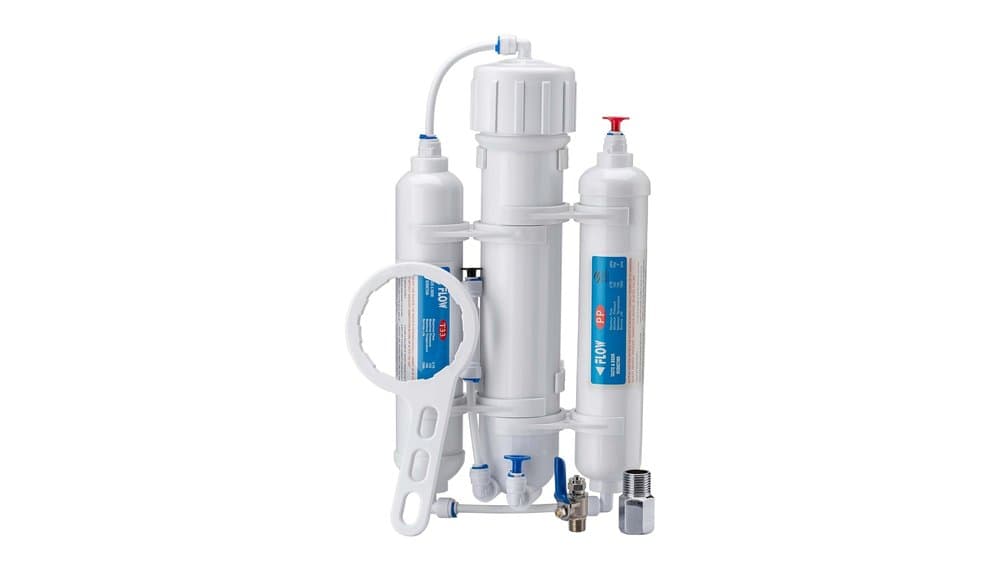
Naturewater NW-3RO-190 Reverse Osmosis System Review
Analysis of the Naturewater NW-3RO-190 reverse osmosis system's performance, health benefits, and practicality for home water purification.
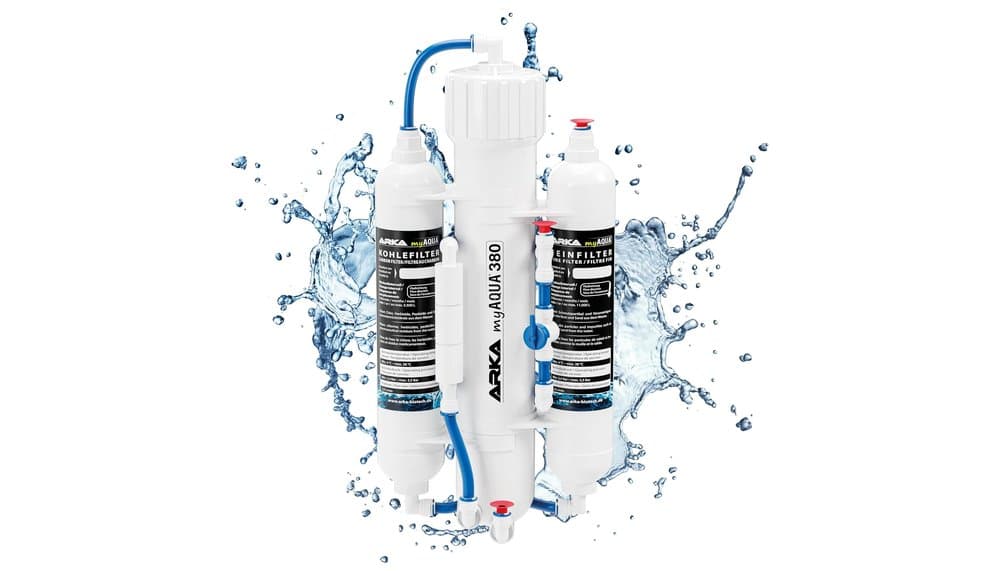
ARKA myAqua380 Reverse Osmosis System Review
Explore how the ARKA myAqua380's reverse osmosis creates pure water, the essential foundation for a thriving, healthy aquarium ecosystem.
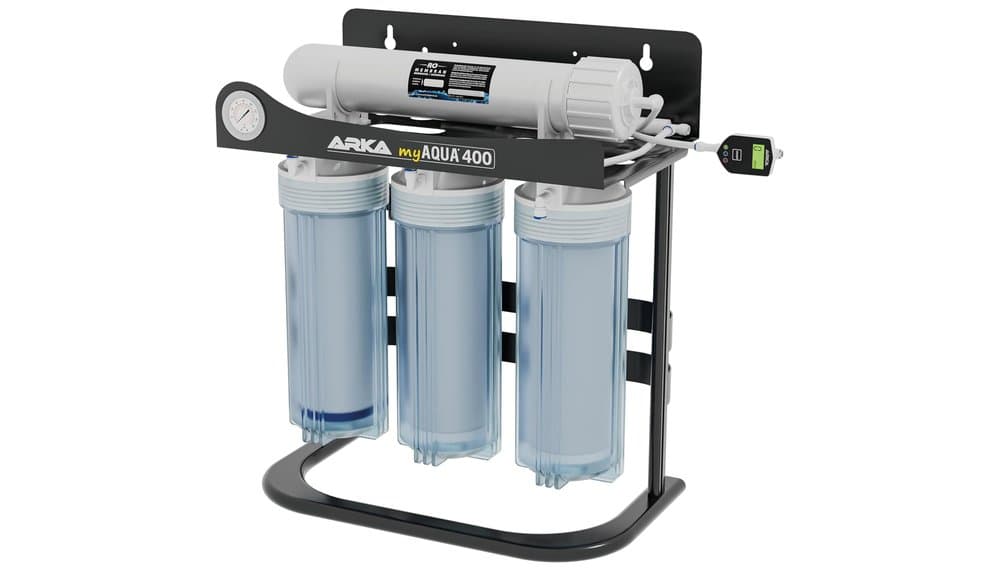
ARKA myAQUA 400 Reverse Osmosis System Review
ARKA myAQUA 400 RO system delivers ultra-pure water for health-conscious homes and sensitive aquariums.